What’s in a Name? How we chose a name for our Chinese daughter, Kayla

Almost seventeen years ago, my husband and I learned that we had been selected by the Chinese Government to be parents of a little girl. We were ecstatic.  Her Chinese name was BiYunYang. But the question for us, as for many new parents, “What would we name her?”

After rejecting a long list of names for a variety of reasons, I remember sitting on the floor at the Boise Barnes and Noble store going through books of baby names. I came across the name Calla.  The name was a derivative of the Calla Lily which grows wild in China and Idaho.  Since our baby had started her life in China but we hoped would thrive in Idaho, I thought this was a perfect name.   The strong “K” sound also went well with my husband’s last name, Kozisek.

I went home and told my husband I wanted to name our daughter, Kayla. I have trouble with pronunciation.  I actually thought “Calla” was pronounced “Kayla”.  He corrected me on the pronunciation indicating the first “a” was short with a strong C in Calla.  “Kayla”, on the other hand, contained a long ”a” and strong” K”. We both were undeterred by my mistake.  “Kayla” seemed a perfect name for our new daughter.  The story of Kayla’s name originating from the Calla Lily, rooted in China and Idaho, is still part of our family folklore.bell-shaped

Every Easter, I buy a Calla Lily from our church youth group to be displayed on the alter. We bring Kayla’s plant home after Easter services and display it on our kitchen table before replanting into our yard. Some years, the lily, a perennial, survives Idaho’s winter and returns the next spring.  But more often, we only have the lily throughout the summer months.  The tall-stemmed plant with the glorious, glistening bell-shaped flower and arrowhead shaped leaves is a regular reminder all summer of the gift we received in spring 2000 from China.

The language of flowers has existed for hundreds of year. For example, during the Victorian period, lovers sent secret messages to one another with small bouquets, called tuzzy-muzzies. Today, the symbolism continues, as lilies displayed at church represent new hope, new life and new beginnings of the Easter season.  I personally believe that we saved Kayla and gave her a new life and a new beginning when we adopted her from China.

golden liliesThe Bible references lilies on a number of occasions.  One of my favorite Bible verses about lilies is Luke 12:27: “Consider the lilies, how they grow: they neither toil nor spin, yet I tell you, even Solomon in all his glory was not arrayed like one of these.” This verse refers to the natural beauty of the earth. God’s world does not need additional adornment.  The verse, however, also reminds me that my Chinese daughter is a gorgeous girl and we are fortunate to have had the opportunity to share our lives with her.

I became interested in Chinese adoption after seeing several beautiful Asian girls in Helena, Montana. When I investigated the adoption process, I learned that these girls were available because of China’s one child adoption policy.  Since boys were seen as more valuable in providing for their extended family in later years, girls of poor Chinese families were given up for adoption.  Many of these girls were left at bus stops, on door steps or otherwise without any identifying information. Relinquishing a baby was also against Chinese law so babies were deserted in public places.

We now know that these policies have proven to be short-sighted.  China has a shortage of marriageable age young women.  Recently, there have been reports of occasional gangs of young Chinese men in rural areas crossing Chinese borders to kidnap young women.

China has lifted the one child rule and made international adoption much more difficult.  But during the period when I was interested in expanding our family, adopting a young girl from China was relatively easy. All one needed was to be patient and diligent about paperwork and have the funds to pay the Chinese government for processing and travel.

Our Kayla lily has proven to be true to her American name. She came to us as a malnourished, 8 month old, weighing only 9 pounds and unable to sit on her own.  Within months, she was sitting, crawling, and full of wonder.  Now 16 and half, Kayla is an honor student and outstanding athlete.  She is a beautiful person both inside and out.  We chose the right name for Kayla. Her soul is truly rooted in the beauty of the wild lilies, that thrive in Idaho.

As William Blake wrote in his poem, The Lily

The modest Rose puts forth a thorn, 

The humble sheep a threat’ning horn: 

While the Lily white shall in love delight, 

Nor a thorn nor a threat stain her beauty bright.

 field of lilies.jpg

My son and I discover serendipity on spring break in the South

My son, Scott (age 22) and I just spent Spring Break together in Destin, Florida and New Orleans, Louisiana. We chose Destin because my son has several friends, Stephen and Jake, who are recent college graduates, commissioned naval officers and stationed in the Destin area. Once our travel plans were underway, I remembered I had snowbird friends, Lynn and Phil from Wyoming who were wintering in Destin.

20160316_124916
My friends, Lynn and Phil from Wyoming who winter in Destin every year.

When I contacted my friends, our visit coincided with their last week in Destin.  Finally, a female college friend,(not girl friend of either Scott or Stephen), Christina, flew from Idaho to Destin for the week. I found her good humor and positive conversation a pleasant addition to the young men. As you can see, our merry band of friends of all ages provided for a positive mix of activities and conversations. St. Patrick’s Day was the Thursday of spring break and while none of us is Irish, my son and I did experience a wee bit of the luck of Irish by the cohesive way all the pieces all came together without any planning.  This coming together in a positive, spontaneous manner is also sometimes labeled “serendipity”.   The Princes of Serendip is the story of three princes who travelled together and shared many great unplanned experiences.  Thus, the word serendipity.  Our spring break was full of many of these moments.


20160315_182606
Destin is graced with beautiful white sand and blue water.

I paid for Scott and I to rent a small condo near the beach and a rental car. We could have stayed free with our respective friends but then we would have spent no time together. This way we got the best of both worlds shared family time and visits with friends. Having friends in the area significantly improved both my son’s and my vacations. In another example of serendipity, our condo was not only a block from the beach but walking distance to both Scott and my friends houses.

IMG_8677
Entrance to the Destin Beach, across the street from our condo.


Destin is known for it’s white, soft sandy beaches and bright blue water. The first day at the beach, I heard a little girl exclaim as she ran on the beach, “Look, Mom, it’s covered with baking powder!” The geologist in our group explained to me that the pure shiny white crystals is because the sand is almost entirely quartz ground up during the ice age.

This was spring break for thousands of college students from Southern schools. Some of the beaches and rolling waves were packed with writhing, undulating bodies enjoying the sun and water spaces  designated  by Greek and/or school flags. There was enough partying  for anyone’s taste with extra law enforcement patrolling the beach and roads. My friend Lynn pointed out the college kids travel in packs of at least 10 or 12. You can spot them by their sun burned limbs, dazed glazes covered by dark shades and  unruly hair. Unfortunately,  we saw ambulances and revival units on several occasions, signifying the good times had taken a dark turn.

20160318_112635
Destin Harbor view at end of day

Because Destin is not as warm as some other Florida destinations, we were able to find places on the beach to spend time out of the college mosh pit. I walked a couple miles every morning on practically empty beaches. On those occasions, I was treated to beautiful  birds, seagulls, seashells on the shoreline and dolphins out at sea. We had several great sea food meals in restaurants fronting the oceans, watching glorious sunsets and boats sailing in the harbor.


On Friday morning my son and I left Destin for New Orleans, a four hour drive on Interstate Highway 10. We were treated to torrential rains, making driving difficult. We knew Highway 10 was closed on the Louisiana/Texas border. We weren’t sure what we would find otherwise in New Orleans. As we drove into the city, the clouds cleared and the sun came out. We spent a glorious afternoon walking the French Quarter. There was live jazz on every corner, sprinkled with street entertainers performing magic, drumming, writing poems and verse on demand, painters, and mimes. We wandered the French Quarter Farmer’s Market complete with real alligator parts for sale. We ate beignets and café au lait on benches watching the harbor.

latte
Sitting outside sipping café au lait is part of the French Quarter mystique.
beignet
Beignets are a New Orleans pastry

A beignet is the French term for a pastry made from deep-fried choux pastry and no visit to the French Quarter is completed without getting covered with powdered sugar from this local delicacy. Just as we were heading back to our lodging the rain started again, perfect timing or kismet.


I had decided to spend the extra funds to stay in the French Quarter.

Jean Lafitt House
Jean Lafitte House in the French Quarter, renovated condos provide a great place to stay and walk.

Our original plans had included Stephen joining us. I rented a two bedroom two bath condo which could sleep six. Since Christina had to fly out Saturday, Stephen said he couldn’t come along. I tried downsizing but I had literally gotten the last room in the inn. On Friday, demonstrating the spontaneity and exuberance of youth, Stephen and Christina decided to drive to New Orleans when Stephen got off work. They picked up the unsuspecting Jake in Pensacola. Lucky we had the large condo because everyone had a place to crash.


20160318_182054
New Orleans Cityscape from our condo balcony


We stayed at Jean Lafitte House on the eastern edge of the French Quarter. Jean Lafitte, the notorious pirate and patriot of the Caribbean, is the inn’s namesake.  Originally built in 1831 as a single house by Lafitte’s fierce captain, Rene Beluche, the inn is a series of restored  condos on the edge of the quarter. Parking is offered for a small extra fee.  The living areas have been elegantly furnished.  Lafitte House provides a relaxing place to stay before and after exploring the rambunctious streets of the Quarter. The inn’s host, Jason, was full of information about local places to eat and where to find great music.  The beauty of the inn is, it is within walking distance of everything in the quarter. While the building is old, the bathrooms have been remodeled, the beds were superb and the thick walls were quiet even in a thunderstorm. The younger members of my group spent most of the night trolling Bourbon Street wrapped in plastic bags because of the rain. But I was cozy using the free WiFi to watch Netflix. Because of the mixed nature of the group, the younger members started calling themselves, The Gumbo Squad.  Gumbo is a stew that originated in southern Louisiana during the 18th century.

On Saturday, we all went to breakfast and had another serendipitous moment when we found a neighborhood breakfast place called Burnt.  We were able to get in almost immediately, enjoyed great Southern food and watched the crowd build up outside waiting to get to get tables.  After brunch, we went our separate ways. Scott and I finished walking the Quarter, just beating the rain. Christina flew out of Pensacola on the red-eye to the University of Idaho and Scott and I drove back to the Fort Walton airport for an early morning flight on Sunday.

On our way home, we were   routed by American Airlines from Fort Walton, to Charlotte, North Carolina to Phoenix, Arizona and finally to Boise. Over our spring break given the bazar flight route we visited seven states or more than 10 percent of the continental US (Utah, Florida, Alabama, Mississippi, Louisiana, North Carolina, and Arizona).  We had many spontaneous,  special occasions. Like the three princes of Serendip, Scott and my spring break was full of  exceptional friends, good karma and serendipitous experiences.


The Global War on Morris–humor with a bite!

The Global War on Morris (Simon & Schuster, 2014) is a political satire written by Congressman Steve Israel, Democrat New York.   My  first thought when beginning Morris was how a  13-year Congressman has time to write  a novel, particularly a representative who headed  the Democratic Congressional Campaign Committee.  On second thought, maybe the debacle of the last congressional elections for Democrats can be credited to Congressman Israel focusing on his novel rather than elections. The current deadlock in Congress has probably given all  435 Representatives and 50 Senators tremendous time on their hands to engage in creative writing, playing cards, hunting with Supreme Court Justices  or other hobbies, since it is clear they are not engaging in the art of politics . The act of political civility as I  understand it requires endless conversations in the arena of ideas  with the goal of identifying compromise solutions. With no willingness to collaborate, there is plenty of time for personal ventures at the public expense.

But I digress, Mr. Israel’s book is a work of fiction crafted by  taking headlines of the War on Terror during the the Bush/Cheney administration and loosely  linking these actual stories into an amusing narrative.  All of your favorite Republican henchmen during the period, Karl Rove, Scooter Libby, Tom Ridge are alive and well in the story line. Vice President Dick Cheney is hunkered in an underground bunker, a Machiavellian puppeteer controlling American’s views on terror. The ultimate goal is not to protect the country from would-be terrorists but to beat Candidate John Kerry in the 2004 election.

I read the book because New York Mayor Bill deBlasio recommended it in the Wall Street Journal’s, Books of 2015 “Who Read What”. I realized once I started reading that the WSJ endorsement was probably a shameless plug from deBlasio for his Democratic friend, Israel, from upper New York.  The recommendation also provided an easy way for the Democratic leadership to spoon feed readers in a humorous forum fundamental constitutional issues  of privacy and civil right bludgeoned by the War on Terror.

Morris, of the title, is an unassuming, nondescript Jewish pharmaceutical salesman living a routine existence with his overbearing wife Rona, a clinical social worker.  These two conventional, average, liberal New Yorkers become mistaken as American terrorists by Cheney and his crew through a series of bizarre and comical  mistakes and poor life choices. As is true of many things in life, the real villains manage to escape while Morris becomes embroiled in an endless round of red tape and bureaucratic nonsense. Rob Reiner & Andrew Lenchewski are adapting the Israel book into a cable comedy series.  If you don’t enjoy reading, you may soon be able to see the plot on television.

While Israel is writing in the theater of the absurd, two real-life points jumped out at me. First, I know Vice President Cheney personally.

Cheney
The author knew Dick Cheney when he was first elected to Congress before he turned to the dark side.

He is from my home stomping grounds of Wyoming.  When he first ran for Congress, he was young and unknown.  I remember receiving a phone call asking me to host a house party for Cheney at my rented bungalow on the fringe of gentrified Cheyenne, Wyoming.  The caller said, “We are having trouble identifying people to support a younger, unknown candidate.”  Cheney, of course, went on to win the election.  In my executive job, I remember visiting him in Washington where he always had time to see Wyoming constituents, particularly those who had helped him get elected.  I also remember running up steps of the stadium at the University of Wyoming football game as Representative Cheney was coming down them.  He called out, “Hello, Julie.” So what do we learn from these little tidbits from my past.  First, everyone starts somewhere.  It is still possible in this country to start out as an unknown candidate and over a long, successful career end up as a Secretary of Defense, corporate titan, and Vice President of the United States.

We also learn that people change.   I have turned into a liberal as I age and see the haves becoming wealthier and have not’s becoming a permanent underclass.  My Democratic friends in Wyoming tease me mercilessly about my support of Cheney but then my sister and I were also Goldwater Girls back in the day.  The same can be said of Cheney.  The man, who was gracious at a rental house party, saw and knew his constituents by name and rose to power in an unlikely manner, seemed to move to the dark side as his career jettisoned.  The lesson here is not that I moved towards the light and he moved towards the dark but rather in life there are many opportunities to change.  I heard a wonderful presentation on homelessness a few weeks ago and one of the featured speakers when queried about the potential of the homeless to improve said quite clearly, “My approach to homelessness is based on my belief in redemption.  No matter how many drugs a person has used or how long they have been homeless, redemption is possible.”  Now in my 65th year, I see where every day there are opportunities to choose the light or dark and we each must define and build our own personal trajectory.

Second, we learn from the tyrannical vision of the unfettered Federal government, that as Americans we do have some very real concerns about the balance between protection of privacy and the need to know to keep us safe. I have to admit that I have not been in favor of Apple’s opposition to providing the FBI with information about how to unlock  the San Bernardino shooter’s cell phone. These people are known killers who willfully shot their co-workers in a planned attack.  The haunting question remains are there others out there waiting their time to strike?  If so, is that information contained in the cell phone data? The Global War on Morris reinforces Apple’s position.  A government with complete access to our personal information and without any oversight body could quickly germinate into an authoritarian regime seeking out anyone who disagrees with it.  I am not sure what the correct answer to the balance of personal privacy versus terrorist among us is.  But after reading the book, I do agree with Apple CEO Tim Cook that this decision  must not to be taken lightly.

apple versus FBI
Apple versus the FBI raises important questions about the right to personal privacy versus the government’s right to know.

Life lessons: Becoming a Graceful Loser

America is built on a culture of winning as exhibited by the current Presidential race. The over-the -top rhetoric and bullying, we see in the debates and tweets are a direct outgrowth of Americans’ proclivity and appetite for winning at all costs. As Vince Lombardi famously said, Winning isn’t everything; it’s the only thing.”

I have to admit I like to win.  In my teens, I successfully ran track. I have a wooden box filled with my track medals (now almost 50 years old). In college, I played on the women’s volleyball and golf teams, always second string but at least making the team. My son, Scott at 22 is a senior playing lacrosse for his university team. My daughter, Kayla at 16 played high school volleyball and club soccer until her ACL was torn a couple of weeks ago. I want to emphasize that as parents, my husband, Pete and I  never pushed our children into a sports.  But if a they chose to go out for a team and were selected to play, we expected them to fully engage. During my sports career and  watching my kids’ teams for the past sixteen years, I have experienced and witnessed a lot of wins and losses.

Obviously, one prefers the elation of  winning. Especially sweet is a David versus Goliath triumphant where you unexpectedly beat an opponent who is on par or maybe better than you on any other day but that one special day you happen to win. Unless, the opponent is truly unworthy a win always feels a lot better than a loss. But losses are part of being in sports and an opportunity to learn some important life lessons.

This spring, my son’s man down lacrosse team, (his team has 15 players where most university teams have at least 30) has encountered a number of losses. The small team means large amounts of playing time but no time for rests or to pull out players who are struggling. Given Kayla’s injury and Scott’s pattern of losing games, the past few weeks have provided me with plenty of opportunity to reflect on the values of losing. Losing with grace requires the athlete develop his/her personal skills in composure, reflection, goal setting and resiliency.

1.Composure: to remain calm and have steady control over one’s emotions in a difficult situation.

Team sports are not for the faint of heart. Even at very young ages, large numbers of parents and assorted relatives show up at games to encourage their individual child on voraciously.  As parents, we receive annual written instructions on being positive and keeping criticism of our child, the coach or other children’s performance to our selves. Unfortunately, few parents heed these directives.  Children are berated from the sidelines for poor plays and scolded as they walk off the fields.  I have seen children leave games sobbing. As children transform into teenagers and college athletes the expectations from the crowds grow geometrically.  Winners are celebrities and losers can be booed by the fans and harassed in the media. One unfortunate Boise State University field goal kicker even received death threats for missing a field goal for a conference championship.  A player who is able to develop the composure to loose with humility, wish the other team well for their winning efforts and walk off the field with his/her self integrity in place to play another day is a great athlete and role model.

Given our cultural focus on winning, learning to lose with grace is not easy.  When my daughter, Kayla,  tore her ACL, she was up one moment kicking the ball and knocked flat the next by the opposing team player.  The referee ordered Kayla to get up.  She couldn’t move.  At that point, our coach went out and carried her off the field.  I tried to take her home but she wanted to stay for the game. She told me later at the emergency room, she was really proud of herself because she didn’t cry.  I told her it would have been fine to cry.  She said one of her goals was not to be one of the overly emotional girls on the field who cry about everything.  I hardly think anyone would judge her for crying over an injury but controlling her emotions was an important personal goal. She performed magnificently.  While I can understand the frustration of tears at a hard fought game, teams and fans need to develop the internal control to be good losers as well as good winners. Threats, name calling, and unwillingness to acknowledge the other team have no place in sports.

2. Self-reflection: to engage in serious thought about one’ action

There is nothing worse than a sore loser who blames his/her team mates, the coach, the play calling, the other team, the referees, the weather and everything else for a lack luster performance. The best athletes accept the loss as the opportunity to honestly review what he/she could have done differently and use the self-assessment  to improve their performance in the future.

3. Goal setting: to establish something you want to accomplish with measurable steps to achievement

Based on self-reflection, an athlete’s next step is to establish personal goals for improving his/her performance in concert with his team and coach. This weekend, my son’s team lost a big game to a team ranked in the top 20 in the nation.  My son’s team held the offense to a low score in the first half but were blown away in the second half and never scored at all throughout the game.  In the midst of the second half, my son missed a key, easy pass which led to an immediate goal by the other team.  Even as a mom, who knows little about the sport of lacrosse, I could see this was an error on his part. When we talked about it after the game, Scott was honest in admitting he had not played his best, he had made a number of mistakes and would have to work harder for the games coming up next weekend. My advice was to review what he could have done differently and then shake it off. There is no point in beating yourself up after a game or in life.  But there is every reason to understand what you can do to be successful the next time and take the necessary steps to improve your performance.

There is a great deal of personal satisfaction in assessing your performance, seeking ways to improve and meeting your personal goals.  Arthur Ashe, the great tennis star, explained reflection/goal process as follows; “You are never really playing an opponent. You are playing yourself, your own highest standards, and when you reach your limits, that is real joy.”

4: Resiliency: to recover quickly from setbacks and move forward

Unless it is the last game of the season, you and your team will be back on the field within a few days or weeks. I have seen young athletes and parents become totally discouraged by the need to go out and practice after a loss, even more so after a series of losses. I have seen young athletes quit because they aren’t winning. I have seen athletes of all ages freeze up in fear the next time on the field because their opponent is bigger, better and stronger than the team that beat them the week before. But playing on teams requires that once  the athlete chooses to play they must fully engage win or loose.  This means that regardless of the outcome of the last game,  the athlete shows up for practice, ready to participate.  To do this, week-in and week-out when a team is not winning requires an athlete  to persist in pursuing personal goals and gaining new skills without the external acclaim that comes from winning and  remain steadfastly committed to other team members. In other words, when athletes lose they must be resilient if they want to continue to play the game.  When they become resilient in sports, they will find that their ability to deal with adversity will serve them well in other life settings.

Let’s face it, as parents we have to remain resilient too. I have sat through a couple seasons of soccer without a single win. The seasons where my kids’ teams won city championships were much more fun. One year when Scott played high school varsity lacrosse, he only got to play in 2 games for about two minutes. My husband and I went to every game to be supportive. One game as we were sitting in pouring rain, I accidently dumped an umbrella of water on my husband’s head as I leaned over to speak to him. He said with a smile, “Are we having fun yet?” Actually, my answer was absolutely! To see my children engage and grow in sports has been a gift which I shall never forget.

Early this spring, my son called from college to tell us that his lacrosse team was small (15 players) and really young, mostly freshman. He wanted us to know since we were planning to attend a number of games that chances were the team wouldn’t be very good. My husband and I discussed this over several dinners and decided we would still show up at the games. We felt that the times when winning is the hardest, are also the times when our son and his team probably needed the most support.

Learning to  gracefully lose, provides important life lessons in developing composure on and off the field, being self-reflective, developing skills at personal goal setting and remaining resilient.  These are not only skills to master in sports but key aspects of living a successful life.

John Wooden, famous UCLA basketball coach who won ten NCAA National Championships in 12 years wrapped up how to address defeat in a three simple sentences; “Losing is only temporary and not all encompassing. You must simply study it, learn from it, and try hard not to lose the same way again. Then you must have the self-control to forget about it.”


Talkeetna, Alaska has a Cat as Mayor

akhwy20-s
June 2014, we took a 7 day road trip through Alaska.

We travelled to Alaska in June, 2014 on a family vacation. While many of our friends have seen Alaska on cruise ships, we chose to fly into Anchorage, rent a car and see the country side up close and personal. I had seen a driving trip outlined in Sunset Magazine that we used as our guide. The Sunset Magazine described a 10 day Grand Tour.  Since we only had 7 days, we opted for our own self-guided “Taste of Alaska” tour. I booked everything in advance. During the tourist season spontaneity in terms of lodging is not a good idea. We flew into and spent our first night in Anchorage.  You know you are in Alaska when there are signs on the walls going into the motel, “Watch out for Moose!”  This was at a Clarion Inn in the center of Anchorage.2014-06-06 08 30 00


Over our seven day adventure, we drove from Anchorage (one night ) to Denali (3 nights), Denali to  Talkeetna (1 night),  on to Seward (2 nights) and back to Anchorage (1 night ) out early the next morning on Alaskan Airlines.  We did not want to spend our entire trip in the car so we cut Fairbanks out of the itinerary.  Anchorage to Fairbanks is a full day’s drive as is Denali to Seward.  From Anchorage to Denali is a 5 hour trip.  Time estimates are based on regular driving.  Since we had gone to see Alaska, our travel times took much longer as we stopped regularly to take in majestic views, watch animals, or visit Alaskan communities.

2014-06-10 20 12 09
Alaska is visual delight!


We saw many gorgeous sites and dined on delicious food. After all, who couldn’t like fresh salmon every night unless you are a vegetarian? While I may choose to share with you other parts of our fabulous trip in future blogs, this blog is focused on the fickleness of the Alaskan electorate. It seemed appropriate given that the presidential primaries are in full swing.

While traveling Alaska, we learned why Sarah Palin was such a popular Governor of Alaska. One small community in Alaska has elected a cat their Mayor for the past 19 years running.  Given Alaskans elect house cats at the local level, not surprising they would elect a mountain lioness like Sarah-Governor.  Claiming to be able to  “See Russia from your porch” is formable campaign rhetoric, especially to a population that thrives in vast expanses of unfenced territory where there are more wild animals than people.

Talkeetna (population 876) is a historic village at the base of Mount McKinnely.  The community serves as  the take off point for climbers who plan to scale the mountain.

Denali_Mt_McKinley
Mount McKinnely in Denali National Park

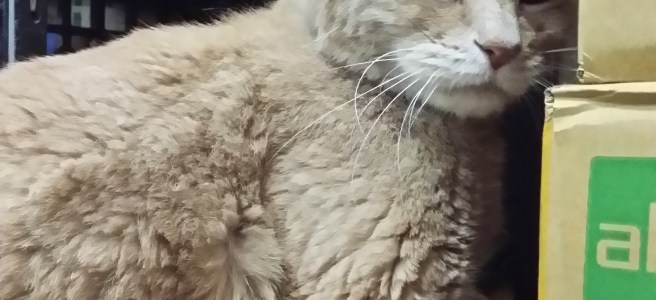
The town is presided over by Mayor Stubbs, a cat.  Stubbs is 19 years old and has been honorary Mayor since he was kitten.  Town lore is that Stubbs was elected Mayor by write-in vote when the citizens of Talkeetna did not like the human candidates.  Those of us watching the Republican Presidential Primary season can certainly understand the populist rebellion against all the candidates. Stubbs long retention in office is  attributed to his appeal to tourists (30  to 40 people visit him every day).

When we went in Nagley’s General Store where Stubbs resides, we were told we could take pictures but couldn’t bother him because he gets tired of all the attention.  Stubbs has been featured in the Wall Street Journal, New York Daily News, and CNN.  The media’s obsession with Stubbs, demonstrates  the media will do anything to generate political stories.

Stubs Mayor
Mayor Stubbs in his prime.

Stubbs got his name because he does not have a tail (though he certainly has many tales). Like many politicians, Stubbs has had his share of burdens from constituents.  He’s barely survived an attack by a canine, placing him in the animal hospital for 9 days and resulting in donations from all the world to pay for his care.  He has also been shot at by BB gun-wielding teenagers.  Taking the ole’ saying out of the pan into the fire literally, he has fallen in deep fryer (which thankfully was turned off at the time).

If you are experiencing political discontent over the current presidential primary cycle, think about writing in your favorite cat when you vote. After all, the domestic cat has shown throughout its long history that it is able to learn, problem solve, adapt to their environment, acquire new behaviors based on new situations and communicate effectively.  These characteristics sound like excellent skills for any politician.

Your other alternative is to act like a cat, ignore primary season and plan an early spring trip to Alaska. If you go, you will find yourself creating wonderful memories of glaciers, mountains, wildlife and unique Native cultures.

brown bear
We saw both brown bears and Grizzlies while in Alaska.

If you happen to stop by Talkeetna to meet Mayor Stubbs, take the time visit Talkeetna Spinanch Bread, an airstream trailer serving great grub. e932f5e2bf61e9854bea92862568f4cd Your stay wouldn’t be complete without breakfast at the Road House, known for it’s bigger than life pancakes for almost a 100 years.

food on the line
Breakfast plates stacking up at the Road House.

Stories of Heartbreak

I go,

you stay;

two autumns. (Buson)

 There is a story in every breakup.  Heartbreak, crushing physical pain compressing one’s chest, is a universal emotional experience. A tour last week of the award-winning Museum of Broken Relationships reminded me that even after a relationship is over the pain lives on in one’s heart. Many of us cherish the mementoes of love gone wrong reminding us of bad past choices or nurturing the fading memory of the beloved.  The museum is a touring collection of artifacts of lost relationships  Half of the display has been collected by curators Olinka Vistica and Drazen Grubisic over a 10 year period from all over the world. The other half of the display is objects submitted by individuals living in the Treasure Valley specifically for the Boise exhibition.  Amazingly, while the objects and stories vary greatly, the yearning and pain of break-up seems to be shared across time and countries. On Display February 4-March 3, 2014, Ming Studios, Boise, Idaho (mingstudios.org)Ming.jpg

Is it really surprising in a culture that celebrates love and relationships, there is an archeology for the lovelorn?   Through romance novels, pop music, movies, and holidays we have created the fantasy that the right connection leads to bliss.  The tokens of broken relationships and their stories capture the giddy, glow of first attachment where the beloved can do no wrong. This glow can last for minutes, weeks, months or years. There are stuffed bears, Godzilla replicas, wooden soldiers, hand carved pigs, bright pink flamingos.  Little gifts given in an affectionate moment or bought on shared excursion become the symbol of the “we” in our happy prime. Notable is that the items that have the most meaning are frequently of little value except in the context of the couple’s shared experience. These small symbols capture us “falling in love” and being “love sick”.

car
Small toy car, an example of shared tokens of love with little monetary value.


When we are sick of love, we can be quite cruel in how we end it.  One young woman received a set of unattached guitar strings with the note, “No strings attached.”  Another young woman received a placeholder ring for an engagement ring.  The ring turned her finger green after a couple of weeks so she stopped wearing it.  When she tried to talk her fiancé into the real thing, he just disappeared from her life.  She kept calling him but he didn’t even have the courtesy to break up. She held on to the tarnished fake but finally felt it was time to move on, and thus, the ring became a donation to the museum.  One woman described a broken relationship with a man who in retrospect she thought was trying to kill her on a scuba diving trip.  He had taken out a life insurance policy before they left town.


One of my most embarrassing moments in college was when a boy friend, I had just broken-up with, dropped everything I had given him on the front steps of the women’s dorm. Since we had hours back then, (women had to be in at a certain time), he strategically waited until hours had come and gone. Everyone in the dorm got to witness all the strange little shared souvenirs of our time together being stacked up on the front porch.  Humiliating indeed, but a good reminder of why I didn’t want that man in my life long-term.


We tend to think of relationships largely in terms of couples, whether they be gay or straight. But the museum also chronicles broken friendships and fractured families.  I have recently had a number of conversations with friends trying to heal from lost jobs. Obviously, painful relationship can take many forms. To be human is to have a host of complex interwoven interactions. Loss of any of these intense associations may seem like the end of the world while going through the healing process.


One of the most haunting mementoes from the exhibit is a set of ear phones. There is a Dad’s message on an old telephone machine saying, “I love you, please call–beep.”  A young woman, answers back numerous times, according to the beeps with profanity and promises never to speak again.


The exhibit also narrates efforts to heal. One woman knit a sweater of everything that reminded her of her former boyfriend.  She had bought the yarn to knit the sweater while they were together, “He started talking about the ultimate sweater…I wasn’t going to begin this project until he settled on what he wanted.  He never did.”  Like the relationship the sweater is misshapen and un-wearable but hopefully the act of creation helped reduce the pain.  Another woman did a video chronicling a joyful period leading up to violence. Since she completed the video, we know she lived but we also know many do not extricate from violent relationships. When you have had an intense loving relationship with someone and end it, there is pain. While the pain heals with time, there remains as soft spot that if jarred can bring up the memories of the one lost. 

 This universality of human pain and loss is documented by Shawn Mendes in the recent hit “Stitches”

I thought that I’ve been hurt before But no one’s ever left me quite this sore Your words cut deeper than a knife Now I need someone to breathe me back to life Got a feeling that I’m going under But I know that I’ll make it out alive If I quit calling you my lover Move on…


Needle and the thread, Gotta get you out of my head Needle and the thread, Gonna wind up dead Needle and the thread, Gotta get you out of my head, get you out of my head

(Danny Parker, Teddy Geiger, 2015)

In 1974 on Casper Mountain, I learned fairness and equity go hand in hand

Elton John Taco Bell Arena, October 2015

Last weekend I attended the Elton John Final Curtain concert at Boise’s Taco Bell Arena. During one of his songs, a picture of a wedding cake with two men on top flashed on the big screen bringing a huge shout out from the 12,000 fans.  This response to gay marriage in Idaho, absolutely amazing! One year ago this week, Idaho allowed gay and lesbian marriage.  Our Governor and legislature fought this action every step of the way in the courts.  Idaho taxes paid $457,000 for this staunch opposition.  This week on public radio there was an interview with the one of the lesbian couples in the legal challenge.  Asked how their lives were different, they said they were able to return to normalcy without stress of one court action after another.  As a married couple, they now have legal benefits such as medical insurance, ownership of a home and being named on their child’s birth certificate.

This discussion led me back to the summer of 1974, a summer memorable because of Watergate and President Nixon’s resignation in August.   The summer of 1974 is memorable to me because it was the first time I confronted  gay and lesbian rights. I spent the summer on Casper Mountain as a camp counselor at a Girl Scout Horseback Camp.  In my first year of graduate school, I was lead counselor for a large number of girls and several other counselors.  The camp was over enrolled. Leaders were responsible for planning one meal a day outside.  We were in tents up a mountain side with wooden floors. I remember spending many evenings out in the rain, wrapped in a green plastic tarp with a shovel dredging around the wood floor to keep sheets of water out of the tent.  Or trying to get a campfire going to feed hungry girls as the rain slogged down. We were on horseback, the main activity of the camp, rain or shine, every day.  We spent two weeks up the mountain, a weekend off and then 2 weeks on all summer long.  I would visit my aunt in Casper on my weekends off, where she would soak my muddy socks in bleach and I would luxuriate in a bath and understand the lavishness of having a bed with clean sheets.  Otherwise, we were isolated up a mountain with only women and girls 24- 7.

About 4 weeks in, the counselors were called to an all staff meeting where it was announced that two of the counselors were sleeping together. Gay issues were definitely in the closet in Wyoming in the seventies.  As a graduate student at Arizona State University in sociology, a huge campus in a liberal discipline, I wasn’t totally naïve about sexuality.  But it took me a minute to wrap my mind around the dialogue.  There were two counselors in every tent and all the girls, so of course, we were all sleeping together.  Since lesbianism wasn’t openly discussed, I didn’t immediately grasp that we were talking about two camp counselors having an affair.  I remember general outrage among other counselors.  The final outcome was that two  women couldn’t share a tent or see each other socially during the camp because those of us with boyfriends weren’t able to see our ‘men” while on duty up the mountain. Looking back on that discussion now, I am amazed that we discussed it openly, resolved it based on the issue of equity and went back to slinging real mud out of tents precariously perched on rough terrain.

Since then, I have reflected on my Aunts Florance (Florrie), a giant red-haired woman and Lillian, petite sparrow-like creature. As kids in the fifities, we would go to South Carolina, visit my dad’s family including his mother, brothers and these two spinster aunts who lived together. I would wonder on the vast differences in their appearance and was never sure of Lillian’s relationship to us. Florrie clearly looked and acted like my dad’s side of the family.  Now I recognize that Florrie and Lillian were probably lovers living under the cover of spinster aunts. I am sure that in the small southern community of Lancaster, South Carolina the relationship was known and accepted if not necessarily endorsed.

In the sixties in Cheyenne, Wyoming, we had two teachers who lived together; Miss Kepner, the PE teacher and Miss Shubert, the choir director. They were known for their great teaching skills, their hard-nosed grading and for being peculiar.  A few summers ago, I was back in Wyoming visiting friends.  I saw Miss Kepner helping an extremely frail Miss Shubert to a park bench. They sat down and Miss Shubert leaned her head on Miss Kepner shoulder.  Such a small jester, but a clear image of intimacy, I actually felt like a voyeur.

In 2003, Massachusetts became the first state to legalize same sex married. At that time, CNN noted, 60% of Americans opposed gay married.  Between 2003 and 2015, the percentage of Americans supporting gay marriage rose to 55% (Pew Research Center).  In 1974 on Casper Mountain, young women helping educate America’s future leaders decided that same sex dating was not a problem but an issue of fairness.  Swamped with mud and focused on getting through the day, we were too busy to judge people and their private lives, but we wanted everyone treated the same.  Between 1974 and 2014, most Americans came to the same conclusion:   Fairness demands that we be able to protect the rights of those we love through marriage.

Fairness and equity go hand in hand