Creating art is in our DNA

The  Essence of Art:  man’s selective re-creation of reality (Ayn Rand)20160527_190313

Creating is in our DNA. The earliest documented art, found  in Indonesia, are carvings in a shell with a shark’s tooth dating back 540,000 years (pre Homo sapiens). Just this week, scientists in France dated elaborate stalagmite structures in a cave underground back to those supposed stupid, rude and untalented Neanderthals thriving over 150,000 years ago.

Pottery, objects made from fired clay, are the first synthetic objects made by humans. Since clay is found throughout the world, a variety of objects from many places have been found dating  about 30,000 years ago. Relatively, new in the scope of world affairs.

Man started making pottery when we evolved from a hunting and gathering into agricultural societies. That makes perfect sense to me.  Nomads chasing wildebeests with rough edged arrow heads, hand-carved from rock, would probably not be inclined to haul a lot of earthenware around with them. Crockery, the growing of grain, and cooking seem to all go together not only in man’s development but in my sense of the history.

Pablo Picasso once said, “Every child is an artist. The problem is how to remain an artist once he grows up”.  Since I retired in November, I have been awaking the inner child artist in me.  As regular readers of this blog know, several weeks back I have been busy with papier-mâché (see https://wordpress.com/post/julierobinsonblog.com/2549 ).  Starting in March, I took an 8-week beginning pottery class at our local community center.  The class met every Wednesday for three and half hours.  There were ten of us in the class. Most were seniors though we had one very talented younger woman, who had moved to Boise a year ago, and two young disabled male adults.  Several of the retired women had taken the beginner class previously and worked on their own projects instead of following the prescribed class instructions.

Our instructor, Chris, is coordinator of the arts at the community center. He is Irish with bright red hair, a quick smile, great patience and kindness.  He holds a degree in fine arts from Boise State and is a master potter, known in the region for some of his works.  He told us he couldn’t imagine getting through college until he discovered pottery in high school.

Our class began with learning how to throw pots on the wheel.  I found I was not good on the wheel.  My legs would shake and subsequently my hands, braced on my legs couldn’t find “center”. “Center” is a key beginning point of pulling a beautiful tall pot.  As a beginning class, most the wheel-thrown pots stayed at 4 or 5 inches and were shaped largely like coffee mugs.  But my pots were only about an inch and that was after great help from Chris.  I couldn’t find one of my pots to glaze but the one I did is glazed in my favorite blue.

Scott, my son, says it looks like an ash tray.  But I’m using it on my dressing table to hold earrings.  I love the color.

One of my thrown pots started to go off kilter. At about this time, Chris told us to start using our imagination to make our pots more whimsical.  He meant different heights and designs on the wheel.  But I took his directions to be an invitation to move into fantasy land. I pulled my thrown pot further off center.  I subsequently marked up the skin of the pot with wood imprints.  Once stained brown and green, I think of it as my “tree trunk” entry into Neverland and the lost boys.

I found I was in my element working with slabs of clay. The slabs are made by kneading the clay into bricks and then pulling the squares through a roller.  The resulting slab is about ¼ inch thick when appropriately rolled.  Our first slab assignment was a box with a lid.

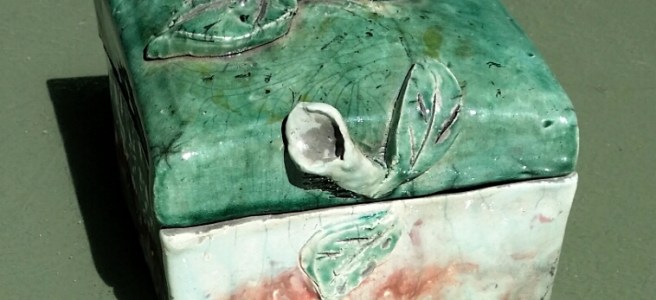
The box is made by careful measuring, cutting with an exacto knife, piecing together the parts and then hitting the clay with flat wooden spatula to solidify the form for firing. My box has a Daisy on top. I had a grandmother named Daisy and my niece is named Daisy. The Daisy is also the symbol of PEO, a philanthropic organization that provides scholarships to women. My sister is the current state president of, Idaho PEO, an organization of over 3000 women.  My mother was the state president of PEO in Wyoming when I was in high school. On the front is a white calla lily.  My daughter, Kayla, is named after the calla lily which grows wild in China and Idaho (see https://wordpress.com/post/julierobinsonblog.com/1742).

I have my box sitting above my computer in my office, a reminder of how many strong women have supported me in my life. The colors are a little too greenish for my taste but this is the result of limited choices for our first glazing experience.  We had a choice of two whites, a non-shiny copper and the green iridescent.  I have learned while watching others glazing in class, glaze is not a precise science.  One has to put on the glaze and wait to see what emerges from the interaction of fire and paint.

My final product and probably my artistically best object is a pinch pot. The pinch pot is made by taking a clay in the shape and size of a baseball  and slowly pinching it into a pot.  As the class went on, we all became more experimental and creative.  I created stripes and circles on the pot with waxed paper coated on back with a sticky substance.  Areas covered with paper when dipped in the first glaze could be left to turn black, the result of no glaze. This can be seen on the black areas of the daisy and calla lily on the box.  I chose to pull off the paper and dip my pot again in the white bubble glaze.  This glaze provides texture and resulted in the copper accents where previously I had paper strips.  I have this pot proudly displayed in my living room on our bookcase of art objects.  It seems to fit right in.

A number of my classmates chose to enroll in another class right away. I love the summers in Boise and would prefer to be outside rather than in a class room. After eight weeks, I picked up my tools, my pots, and donated my left-over clay to the community center.

I may choose to take the beginning class again in the fall or winter.   If I choose to take it again, I will focus on the areas that gave me the most joy, i.e. the hand-crafted items.  By taking the beginning class and trying both throwing pots on the wheel and creating free-form, I have much more respect for the technical skill necessary to throw a gorgeous pot.

Our instructor, Chris would tell us to listen to the clay and then your art will emerge. He cautioned us against starting with a preconceived idea of where to end up. Using this approach, I created an entrance to Neverland, a strong women’s box, and pinch pot dipped in the glaze called pond scum.  I found as Pablo Picasso advised my inner artist.


Jurni: providing a seat disguised as a bag

My family and I have travelled to the Orient, Europe, England, Ireland, Scotland, Mexico, Canada, Alaska, Hawaii and extensively in the U.S.  Our number one rule is that you have to pack so you can carry all your gear on the plane.  I have traditionally carried everything I need for up to ten days in a roller bag meeting airline carry-on regulations, a backpack and a fanny pack. I strap the fanny pack to my waist with my phone, money, and passport and only take it off at night to make sure my valuables and I are never separated. In a pinch, I can get the fanny pack into the backpack so I meet the two bag requirement of the airlines.

My two kids have been responsible for pulling their suitcases and  carrying their back packs since they were old enough to travel. Fortunately, bags and backpacks come child- sized. Kids don’t bring many clothes. The ones they bring are tiny. When the kids where younger, their clothes went in the roller bags and their backpacks were full of entertaining objects such as coloring tools, paper, Gameboys, and playing cards. All of this has become passé with the advent of  smart phones and iPods which entertain my children for hours. I see very young children playing with in airports now.

We made the decision  to wean down our wardrobes and keep our luggage with us because of lost luggage leading to problems at our destination. Now we travel with our luggage to assist in making connections if we have to change itineraries, reducing the problems of dealing with lost luggage and trying to keep the price of travel down. Taking four us to Spain or Hawaii and paying luggage fees for everyone becomes extremely costly.

Recently, I have become the drag on our traveling caravan. I have a very rare neurological disorder. I can walk just fine (for which I am very thankful). But I can’t stand for any period of time without my legs starting to shake. At the same time the lines for airport security are growing, my ability to stand is diminishing.

When my son and I travelled from Florida to Boise in March, I had trouble at the Pensacola, Florida security check. We had waited a long time. I told the screeners I had trouble standing but I couldn’t get them to listen. When I walked through the scanner, the equipment showed me carrying weapons all over my body i.e. in my arm pits, waist band, bra, anywhere that moved as my legs shook. After a humiliating body check, I complained to the supervisor who said I should have told the initial TSA worker. I had, of course, done this. In fact, I had told two workers but they were too busy to listen. Given this experience, I decided I needed to take matters into my own hands.

Flying home from Seattle a month ago, I received a text from Alaska Air that the lines at Seattle International Airport were two hours long. I asked for a wheel chair when I got to the airport. Once in the wheel chair, we zoomed right through the crowd. However, I was physically in better shape than the kind woman pushing the chair. As soon as I got into the boarding area, I was up walking around. I felt uncomfortable being pushed around when I’m perfectly capable of walking. Given the Florida and Seattle experience, I have done two things that I hope will improve my air traveling experiences.

The first is that I am now on the TSA priority boarding list. For a long time, I routinely got priority boarding but recently I have not. I am obviously not in a position to hope for the luck of the draw. I paid the $80 and scheduled the time to be fingerprinted. The next time I fly, I will enter my number TSA number and be able to skip the longer screening lines.

The second thing I have down is purchase the Jurni, a bag designed to  be a carry-on but also to sit on (https://www.indiegogo.com/projects/jurni-the-ultimate-sit-on-carry-on-suitcase#/) My daughter, Kayla, found the bag online when the luggage was still only a concept on a go fund me page. If you put in the funds to help develop the proto type, you got the bag when they were ready to be shipped.

My bag arrived this week. As promised, I can pull it easily  behind me and sit in it like a horse and scoot around the house. Now, rolling around a crowded airport may be a different thing altogether. Sitting on it like a chair is tipsy. I feel like I’m riding a rocky boat or I had too much to drink, a disconcerting feeling and the wheels can go out from under you throwing you to the floor. Thus, the bull rider approach with my legs anchored around the Jurni, I am in control of its movements for short distances. In other words, I would propel me along in a line.


The bag is tiny. I can see why it is designed for teenagers. My 16 year old daughter wears an extra small in most clothes and a size 0 in jeans. Until Kayla grew into these sizes, I actually thought they were pretend sizes to finish off the clothes rack. I remember standing in the Abercombie store when she shouted over the dressing room divider that the zero was too big and she needed a double zero.  Really,  a double zero! I wasn’t that small in grade school. Kayla could easily put a week’s worth of clothes into the little compartment designed for clothing.

I am not Kayla. While I am not enormous, I have grown heavier with age. The possessions I notice that now take up the most room are my bras which have grown geometrically since giving birth and breast feeding. The movement up to a D was bad enough but now on the downward slippery slope of aging, my circumstance is 2 inches bigger and I need wire armor to keep my cascading physique in place. The same is true of my swimming suit which used to be teenie weenie but now takes up the space of a small sea monster in order to pull me in all the right places and hold up those previously mentioned descending  upper body parts. Deciding what to take and purchasing travel clothes that meet all your needs while fitting  everything in small compartments takes significant planning.  My first thought when I looked in  the Jurni was I was going to need to  work on loosing more weight and buying a new  smaller traveling wardrobe (double zero, here I come!)

The good news is that the Jurni knows it’s packing compartment is tiny and for an extra cost has included zip bags to scrunch all my jumbo items into the size of my daughter’s size small. I tested the feasibility of utilizing the Jurni for a real trip rather than riding around my living room by laying out the wardrode I took to Mexico in January and seeing if I could fit it in the case. Much to my amazement, I got 3 pairs of long pants, 3 long sleeved shirts, 4 short sleeved shirts, 2 pairs of shorts, the iron maiden bra and sea monster swimming suit plus rash guard jacket, my traveling pjs (light weight), my wash out panties (3 pairs) seven pairs of white cotton socks ( I always wear socks with my hiking shoes) and  a pair of flip-flops. I actually called them thongs (my daughter was horrified). Appparently, thongs were shoe wear in the seventies but are strickly underwear in the twenty first century.

The little plastic buttons on the Jurni that serve as openers seemed a little stressed by my wardrobe. I am now on the look-out for a band to go around the Jurni once packed. The company sells a check-in strap and lock. But the strap goes from top to bottom and prevents you from utilizing the pull up handle. I would also be sitting on the buckle which  seems weird to me. I want something that goes around the middle, doesn’t interfere with the handle but guarantees that the iron woman underwear is not strewn all over the run way as I board a miniscule Alaska Airline plane where all carryons are actually always loaded under the plane.

I can’t provide a full evaluation of the campabilities of the Jurni until it actually goes with me on a journey. That may be a few months off. After jaunting all over the world and the U.S. the past few months, we are spending our summer in the Mountain West. Afterall, why go any place else when you are already there.

Frank Church Wilderness
Frank Church Wilderness Area, Idaho


Follow-up to blog on What’s in a Name

The Kayla (Calla)  lily we planted in our garden in honor of our daughter from China is flourishing. The blog about Kayla and her flower can be found at https://wordpress.com/post/julierobinsonblog.com   What’s in a name?

20160523_180457
Kayla’s Easter Lily in full Bloom

Barney the Beagle–Paper Mache Replica of My Childhood pet

Papier Mache: French for chewed paper

Recently, I joined a women’s organization that hosts an annual Christmas bazaar to raise funds for education.   We are all supposed to make something to sell. I was born with very few arts and craft genes.   Since the first recorded cave art is over 500,000 years old, some of our early ancestors definitely had these genes and passed them on to a few lucky souls.  You and I all know the person who shows up  and can fashion a felt hat from a knit sweater or a gorgeous quilt from a rag bag, or takes home the hodge podge of objects contributed by parents to the school auction and produces a world class auction basket.  I stand in awe of these people.  I am not one of these people.

My freshman year in college, I took up knitting. I made dozens of extremely-long, odd- shaped scarves using the basic knit one/pearl one stitches.  Everyone I knew ended up with one of these slinky reptilian beasts.  As a child, my mother did her best to endow me with some homemaking skills.  I was enrolled in 4-H for a few years. I turned out passable aprons and gathered skirts, resulting in blue, red and white ribbons at fair.  My muffins had tunnels, little holes made by too much air–no ribbon at the county fair.  I did win the purple ribbon and best in class, one year for my meal plan.  In retrospect, this award is extremely ironic because I don’t cook much at all.

While suffering angst over the bazaar challenge, my sister, Jane, reminded me that as a child, I was a whiz at paper mache. My skill wasn’t because I wanted to produce great art.  I was fascinated by puppetry.  I’d make a variety of puppet heads with died cotton ball hair and whip up their outfits on our sewing machine. Then I would write elaborate plays for my friends and I to produce.

My first thought was there wasn’t much interest in paper mache anymore. I couldn’t have been more mistaken. When I looked up a paper mache refresher course on YouTube (source of all things educational),one sweet-looking elderly lady, Joni Good at http://www.ultimatepapermache.com  has a blog, numerous books and dozens of YouTubes.  Her recipe for paste has over a quarter of a million views. A second teenage girl has over 200,000 views demonstrating Joni’s recipe.  One man has over two million views on how to make a piñata. An attractive lady making a paper mache bowl has over 1 million views.

Apparently, there are a lot folks out there making craft items out of paper and paste. My sixteen year old daughter, Kayla, says there are just lots of people who like to watch YouTube and aren’t making anything. Surely these high numbers of viewers reflect some papery product being produced somewhere and not just viral surfers and paper stalkers. Given this huge viewing volume, I thought why not give it a try again? After all in the scope of human affairs (homo sapiens as we know them have  been around for more than 200,000 years), 52 years of not touching anything related to paper mache isn’t that long a time.

Paper mache originated in China during the Han Dynasty (BC 202 to 220). The Chinese made paper mache helmets that they hardened with lacquer. From China, the craft spread to Japan and Persia.  Those elaborate oriental masks, you see when you travel  are  paper mache.  When the art of paper mache reached France, the French, always unique, decided to create their art by chewing up the scraps of paper. Chewing paper would, of course, give you small pieces of sticky, damp paper to work with but sounds disgusting to me.  When I began my paper mache project, I rejected the French approach and used the yellow pages approach, “let your fingers do the shredding”.

After reviewing some of the videos on new approaches to paste (joint compound, linseed oil, and Elmer’s glue), I elected to go traditional. My first project is made of paste from flour, salt and water (recipe below).  A an empty toilet paper roll  and Styrofoam round ball provided the infra structure. I used newspaper for the coating.  Using household products did result in the bumps in odd places that led Joni Good to make up a more elaborate paste recipe.  But I am still taken with the more modest approach to paper mache because as a child, I remember we could just go to the kitchen, whip up paste without the hassle of gathering together a lot special stuff and have our theater cast underway in no time.  I think there is something to be said about being able to create when the urge strikes you, especially when children are involved.  In addition, the flour and water is easy to clean up with soap and water, inexpensive and very forgiving when you make errors.  Finally, it is not fast drying—a plus for joint compound and glue but a negative if you want to rip off some error you have made.

I am also taking a pottery class. In pottery, our teacher is always telling us that the clay speaks to us.  I was originally going to make a reindeer (remember this project started for the Christmas bazaar in 9 months). When I got started on the reindeer, he morphed into a beagle.

20160513_152202
Barney, before he got a coat of varnish, eyes and collar

I am very familiar with beagles, we had one when I was child.  For those art critics out there, I know the snout on my paper beagle is too long and his feet too big (blame the reindeer).  My sister, Jane, and I called our beagle, Barney the Beagle with the goo-goo-googlie eyes.  The entire time I was crafting my paper dog, I was thinking about Barney.  As you can see, Barney the Beagle has goo-goo-googlie eyes.


Barney was finished off with acrylic paints, spray-on shiny varnish, and repurposed eyes, nose and tongue from the reindeer I was trying to clone.  I found an unused cat harness in my pet drawer.  Any of you, who have read my blogs on my pets know that Satchel, the big gray Tom Cat wouldn’t be caught dead in a whoosie harness (one has to question my sanity for buying it at some point in time).  I cut up the offending harness and made a realistic collar for Barney.  Satchel was pleased.

I am proud of Barney for a first effort.

20160513_152019
Barney, with the goo, goo, googlie eyes!

He obviously isn’t good enough to sell at a bazaar, too many nasty little dings and bumps.  But he is good enough to give to my husband, Pete, for Father’s Day.  Pete has an office full of items the kids and I have made and seems delighted with whatever we give him no matter how low quality.


I have roughed out an angel and cat to see if I can’t still produce something that someone might buy. I may try the joint compound bending to the will of the masses to have a saleable product. Also from my pottery instructor, art takes time and patience.  I have nine months but at my age I’m not sure I will every produce a financially viable product.  That’s the beauty of paper mache. There isn’t much of an investment if the outcome is poor and you can also toss it in the recycling bin.

Simple Paper Mache Paste Recipe

1 cup flour

1 cup water

3 teaspoons salt

Mix together and start gluing

Most important–Have Fun!

My Tiny Arizona Home, the right size at the time

I am an HGTV (Home and Garden Channel) fanatic. I particularly like House Hunters International and recently, I have started watching Tiny House Hunters.

landscape-1442330245-tinyhouset
Cottage Style Tiny House on wheels

I am intrigued by all the varied designs and nooks and crannies that can be folded into 500 square feet or less. I am also fascinated by the reasons people desire tiny homes.  The premise of the show is that Americans are looking to downsize, simplify their lives, travel more, and just save money. Probably my biggest reason for being interested in tiny houses is that I lived in a tiny home before there was a tiny house movement.


asu-251x240
I received a masters degree in sociology in 1975.

When I was a graduate student at Arizona State University (ASU) in the mid-seventies, my first apartment by myself was a  ground-floor studio  measuring approximately 200 square feet.  A studio apartment combines living, bedroom, kitchen into one space with a separate bathroom. While the new tiny homes may have many exquisite details such as granite, wood paneling on walls and ceiling, my apartment was the scaled down version with cinder block walls, rattan furniture in the living area, a formic dining table for two, wooden beads surrounding the  double bed for privacy, regular closet and a kitchen along one wall. The piece de resistance of the kitchen was the stove with an oven above, pull-out burners and an oven below.   In 1973, microwave ovens were not ubiquitous as they are now.  They were just starting to show up in high end kitchens (first counter top micro wave was distributed by Amana in 1967).  My home had a front porch with patio furniture looking out on a shared swimming pool and a back door that opened to the parking area.  The climate in Arizona is such that having the outdoor space is the same as adding a substantial amount of square footage, especially with a swimming pool available for everyone in the complex. The apartment complex and pool were well maintained and the location was close enough to campus to bike.

I felt like a queen in my special place. One couldn’t do much decorating because of the cinder block  walls. But I did have posters scattered about.  Unlike folks who are downsizing to a tiny house, the studio was  upsizing for me from  a dorm room and then a shared two-bedroom apartment. I had plenty of space for one and I enjoyed having my own privacy.

The biggest drawback to the Arizona place was not size but no pets.  I love animals.   When I was in graduate school, I didn’t really have the time or financial resources for pets so that lack of one was not  a problem.   A few years later when I had a regular job, one of my first goals was to purchase a house so I could have animals without the restrictions placed on pets by landlords.

My memories of Arizona are magical. I loved the University, the independence, the desert, the hot days and cool nights. I have memories of playing soft ball andpar 3 golf during day. At night, we would sip wine coolers on patios warmed by fire pits and accompanied by live music.  These were all new and exotic activities as a cowgirl who grew up in Wyoming and went to a Presbyterian College in Nebraska for my first experience away from home.

While I was at ASU, I had a number of guy friends. One of them, Dave, was a desert rat. He had an orange jeep and would take us out on extreme dirt roads to view the gorgeous red mountains, cactus and wild flowers, all found in isolated, primitive areas.  After one such adventure,  I was cooking my specialty, spaghetti with red meat sauce. Actually, I am not a good cook, so this was my go-to meal for guests. Dave and I sat down to a festive Italian meal and the next thing I know he’s bolting to the bathroom sicker than a dog.

Cleaning up in a hurry, I dumped everything down the garbage disposal immediately clogging the drain. The  maintenance man, Charlie, came right over with a plumbing snake to clear the line. When he started pushing it into the drain, we heard a scream next door. Apparently, the drains were connected and the metal snake had popped out of my neighbor’s sink–a startling experience.  Meanwhile, Dave was moaning on the bed behind the beaded curtains, not enough privacy in times of distress.

Then Charlie removed the U drain below the sink, emptied the nasty red sauce and slimy pasta contents into a bucket.  He promptly stood  up and dumped the bucket into the now empty sink. At which point, the entire contents of the bucket shot through the open drain making a huge mess on the kitchen floor and splattering Charlie and I.

Dave emerged from his bead sanctuary to see what the commotion was about. When he saw the mess, he decided he was well enough to go home and recover.  Dave and I never discussed whether the illness was brought on by my cooking or a rapid stomach bug. I do know he never chose to eat with me again. The lesson from this experience is that houses are like spoiled children in need of regular attention. They have the ability to throw a tantrum by breaking down, leaking, flooding, cracking, at the most inconvenient times. Almost anything connected to a house is expensive. A good do- yourself-person in the family is a gift.

The other memory I have of my ASU home is not so amusing. One week night, I received a phone call from my former roommate, Pat, telling me she was coming right over and to tell no one. When she got to my house, she had a fellow grad student, Kathy with her. Kathy was hiding from her abusive husband. I was the only safe place the two of them could find.  I was safe because I didn’t know Kathy’s husband. Kathy and I sat up all night because Kathy was terrified.  Unfortunately, this happened more than once. I had never seen anyone so frightened as those times Kathy was escaping her raging, violent husband.

There is a happy epilogue to this story. Kathy did finally divorce her husband. She finished her  masters degree,  successfully pursued a doctorate and became an expert in the field of family violence.  As Kathy and I sat together on those terrifying nights, I made up my mind that no one should be that frightened in their home. I have spent many years in Wyoming and Idaho volunteering for and donating to programs committed to providing safe havens for women and children who are victims for domestic violence.

The lesson from my experience with Kathy is that houses (the four wall structure) are not homes (socio-cultural experiences created by the individual(s) living in the structure). Kathy had a better house than most graduate students because her husband had a regular job.  But a physical structure that does not provide safety and is not a refuge in times of trouble is not a home.  Today, in our world we have many refugees fleeing unsafe settings (estimated at about 60 million people around the globe today).  Any night in the United States, there are over half a million homeless individuals (men, women and children). Domestic violence is the third leading cause of homelessness in the United States.  In other words, there are many people in need of refuge in our world today.

My 200 square foot studio apartment provided me with a lovely home for a year when I lived in Arizona.  My home was also a place of shelter for someone else in need.  I am grateful that my life has been blessed with  many homes filled with a great deal of love. Square footage truly doesn’t matter when seeking out a house, but the strength of character  and heart of those who reside within does.

gratitude


LAX Coach Provides Metaphors for Life and Politics

Metaphor: a symbol of something abstract

The last game of the University of Idaho 2016 lacrosse season was a loss to Boise State University. For a loosing season, however, there were a lot of wins.  The Lacrosse End-of -Year Banquet turned out to be one of the most surprising wins from my vantage point.  This was a season that took great fortitude. Fourteen young men played 12 games against teams in the Men’s Collegiate Lacrosse Association (MCLA) from much larger, better funded programs such as Simon Fraser, Canada (lacrosse is the national sport), University of Washington, Brigham Young University, University of Utah, University of Oregon, and Oregon State University.  The U of I ended the season with 10 losses and 2 wins.  But we learned at the banquet, most college teams would not even take to the field without at least 20 players to allow for substitutions. To compete in a major conference with only 14 players and play every game was truly remarkable.

My son, Scott, was recognized as one of 3 seniors on the team. First year, head coach James Courter, talked about Scott’s high energy pursuing a finance/accounting degree, serving as president of his fraternity and playing lacrosse. Coach Courter remarked that Scott has an outlook he labeled “SPA”, superior positive attitude, in all situations.  Courter described how when he first met Scott, he found Scott’s  smiling demeanor somewhat disconcerting.  Courter would be talking about something serious the defense needed to do and he would look up and Scott was smiling.  Courter said by the end of the season, he came to learn that Scott just takes on anything with a smile (not a bad trait in life).

Scott Lax banquet
Scott exhibiting SPA with Coach Courter


The biggest surprise to me at the Lacrosse Banquet was not the kudos from the Coach for the team and volunteers but the Coach himself. Thirty-one years old from Florida, Courter moved to Moscow, Idaho for a part-time coaching position just to get into college coaching.  An outstanding college defensive player in the large eastern lacrosse divisions, Courter played lacrosse at Providence from 2004-07 leading his college team to NCAA Tournament appearances in 2004, 2006 and 2007. He earned Metro Atlantic Athletic Conference (MAAAC) Defensive Player of the Year honors as a senior in 2007.  Since graduating, Courter has worked his way up in coaching from assistant program director of a youth lacrosse program, to head coach of a high school program, and finally to head coach at the University of Idaho.  His vita tells me Courter absolutely loves lacrosse.  He has travelled across the country to work for a pittance for a team with no funding for scholarships or even the power to get the University to allow them to use the much ballyhooed Kibby Dome during inclement weather.  Courter’s resume also reflects a tremendous tenacity to stay with the sport while climbing the difficult to access college coaching ladder.

Courter is tall, slim, losing some of his hair. He came to the banquet microphone with a slightly wrinkled shirt and tie coming unknotted.

Coach Courter
University of Idaho, firs-year, head coach, James Courter

He is obviously uncomfortable speaking to groups from a podium.  But his presentation was outstanding, not because of the delivery, shaky at best but because of the thoughtful content.


He gave the three team captains a map, a compass, and whistle. As we all know who do any backpacking, this is survival gear.  However, Courter is from Florida not the wilds of Idaho.  He never alluded to the true function of the equipment in his presentation.  Rather he talked about metaphors, he had learned from his father.   For success in life, one needs to have a mental map of where you want to go.  But that map needs to be tempered by a heart which serves as a compass.  Is the map taking you in the right direction in terms of your moral compass, the ability to know what is right or wrong and act accordingly.  The whistle can serve two functions; first, stop the action that is not going according to plan or second, alert others that you need assistance.

I spent the weekend reflecting on Coach Courter’s remarks to his captains.   The metaphors of map, compass and whistle resonated for me because of my degrees in public administration and my life-long career focus on government and politics.  I have sat in many meetings where the map would have been much easier to develop and follow if we did not have to be concerned about the moral implications of the plans we are developing.

In my own neighborhood in recent months, St. Lukes Health System, the largest employer in Idaho has developed a master plan over many years to expand their Boise campus by closing off one of the main streets, Jefferson.  The administrators at Lukes have seemed surprised when the neighborhood has raised an outcry about the blocking of a main bike artery and their  failure to ensure the plan was pedestrian and bicycle friendly.  Given the outcry, St. Lukes has subsequently revised their plan, hosted numerous neighborhood meetings and recently sent out post cards to the neighborhood.  But it would have been much easier if Lukes administration had started their plan with not just what is easier and most efficient for St. Lukes (map) but what does the community’s moral compass tell us would be the best approach for serving the East End.  Final decisions have not been made on this issue.  The East End neighborhood was very effective at bringing out their whistles quickly and loudly when they were not involved from the beginning.  The neighborhood protest about the unfairness of not being involved from the beginning was shrill and loud, significantly slowing down the approval process.

We have another example of the map, compass and whistle metaphors in our national government. In the U.S. Constitution, the Supreme Court was established as the final arbitrator of whose map and moral compass should be followed during any period of American history. The Republican majority in the  U.S. Senate have delayed confirmation of a new Supreme Court Justice in the hopes of electing a Republican Presidential candidate who will appoint a justice  closely aligned with their conservative moral compass.  In other words, their map for the rest of the year is delay. During this interim period, the Justices are not able to rule on many controversial issues because they have a tie vote between liberals and conservatives. The fact that the Republicans in the U.S. Senate have essentially negated the power of the court by not allowing a replacement should concern citizens of both political parties.  This is a fundamental violation of the U.S. Constitution.  The Republican Senators are allowing their partisan strategy to interfere with their moral principles.  Without a strong referee, in this case the U.S. Supreme Court, the potential for unintended consequences and long-term harm particularly to vulnerable populations is great.  Right now in our country, there is no one in place to enforce the whistle.

In the end, these three simple metaphors, a map, a compass, and a whistle provide a measure of who we are as individuals and a country. A key question for each of us every day is: How do we develop a positive, ethically grounded future with the ability to ask for help or stop ourselves when we have gone too far?

Mom’s weekend, A quintessential college experience

Quintessential: a perfect example

 My first choice for college was Duke in North Carolina.  My dad was from South Carolina so I had traveled the South extensively as a child.  I knew as soon as I saw Duke’s gorgeous campus as a kid I wanted to go there. When I started my college search in earnest in high school, my parents told me that they couldn’t afford the tuition at a school of the caliber of Duke and travel back and forth from Wyoming made any East Coast school cost prohibitive.  I never applied to Duke.  Instead I set my sites closer to home.

 I attended a small private Presbyterian college in Nebraska, called Hastings College. My primary reasons for going to Hastings were: 1. I didn’t want to go to the University of Wyoming where most of my friends were going, 2. My sister, 3 years my senior, was already at Hastings and was having the time of her life traveling all over the world during interim session (the month of January between fall and spring semesters), 3. My parents could afford both the tuition and the travel though in the end I had a substantial scholarship award, and 3. Ted Menke, a tall, handsome, blonde- haired, blue-eyed senior had led my tour group.  At 18, I was boy-crazy and the thought of an entire new world of good-looking guys in a location outside of Wyoming was a huge motivator.  My sister and I still laugh raucously about what a superb ambassador for Hastings, Ted was. In my case, he had graduated by the time I got there.

chapel
Chapel at Hastings College, Nebraska. When I was in school, we had mandatory chapel every Friday.


I was not disappointed with my Hastings experience though I would never send my kids all the way from Idaho to Nebraska to have a small college experience.  There are many fine small colleges in the Northwest.  I bring up how I chose my college because choosing a college is one of the largest financial decisions a family will ever make.  If I am perfectly honest at 18, expense and quality of education weren’t even considerations for me.  I wanted to go somewhere I could have a good time, make new friends and learn about the world.  Somehow when my son Scott started looking for colleges, I forgot how frivolous I had been.

Scott began his college search in earnest the beginning of his junior year. We did what the high school counselors recommended.  Scott wanted to go to school in the West, if possible on the coast.  We toured schools in Washington, Oregon, California, and Colorado. Based on these tours, he narrowed his search down to five. The top being a stretch to get into but worth dreaming for, the fifth being a sure thing with others in-between.  My son’s dream school was Santa Clara University, a private Jesuit School in California with a gorgeous campus.  His sure thing was the University of Idaho.  He got into all the schools with scholarships. The last school we heard from and the one  he waited anxiously on every day  was Santa Clara.   He received $10,000 a year to Santa Clara.  After reviewing the costs of Santa Clara, we had to tell Scott we simply couldn’t afford it.   We are a physician family and have substantial resources. However, Pete (my husband) didn’t start practicing until he was in his early forties.  By the time Scott was headed to college, Pete was 65 and we still have a daughter to send to school who was 12.  Santa Clara would have cost us $60,000 a year on top of the scholarship.  We had saved for Scott’s college education and had $65,000 in Scott’s  529 college savings account designed to cover the cost of an in-state education at that time.  The costs of Santa Clara would have used all the savings the first year.

Given the costs of education, my husband, Pete set up an elaborate excel sheet so we could compare all the offers.  The best offer was from University of Puget Sound where Scott got $20,000 a year. We thought we could afford the extra cost for Puget Sound though it would have meant more money than we had saved.  But once we told Scott we couldn’t afford Santa Clara, he had no interest in the other schools.  On decision day, Scott was traveling for a business conference. I called to ask him which school I should accept. He said the University of Idaho. I was hoping for Puget Sound.  I was a little sick inside because I had wanted him to go out-of-state. Let’s face it, Idaho is not a cultural mecca.

Scott’s first semester at the University of Idaho did not go well.  He had a strange roommate in the Honor’s dorm.  When he tried to change, the resident assistant told him the only way he could get a different room was if someone would trade with him.  Lots of people were willing to room with Scott but no one was willing to move in with the undesirable roommate. In addition, Scott is a vegetarian and the food situation in the cafeteria was getting desperate.  He sent me pictures from the Cafeteria where there was a big sign that said, “Vegetarian” and then underneath the food was labeled  “chicken wings.”  Pete and I both went up for Dad’s weekend in the fall because we felt we needed to provide support just to keep Scott in school.  We traveled with another family.  We all went bowling.  I will be forever thankful to one of the men in our group.  He said to Scott, “This is your life.  You need to take the necessary steps to make this work for you.”

The next thing I know Scott had joined a fraternity (Phi Kappa Tau), moved out of the dorms and into the frat house.  At the time,  I thought this was like jumping from the frying pan into the fire.

This past weekend, I visited Scott at the University of Idaho for my 4th and final Mom’s weekend.  I started the blog today with the intention of writing about attending Mr. Idaho, a beauty pageant  to raise funds for charity (very fun), the Turtle Derby where the sorority houses train turtles to run out of a circle (captivating in a strange way), and the lacrosse game (another loss but a rousing good time).  But upon reflection, the real story is not how I spent my weekend (truly fabulous) but how much Scott has grown and matured at the University of Idaho.  Despite my misgivings and several stumbles along the way, the U of I has provided Scott with a quintessential college experience.

For example, being in a fraternity  has proven to be a great opportunity for him. The fraternity gave him an instant group of friends.  In addition, they have a cook so his vegetarian needs are addressed if he leans on the cook.  I would be lying if I didn’t say it is hard to be the only vegetarian in a congregate living situation.

Scott has also served as treasurer of his fraternity and is now the President.  He has paid bills, collected funds from reluctant payees, developed budgets, managed staff, and had to figure out how to motivate young men who have many diverse interests. The fraternity has paid for him to attend a number of national meetings where he has made new friends and had the opportunity for additional leadership training

Scott has a Graue Scholarship from the University of Idaho.  The Graues are business students who must maintain a 3.5 grade point.  They receive tuition assistance as well as a funded annual field trip. Scott has travelled to California to meet business leaders as well as major companies in Portland and Seattle such as Nike and Starbucks.

Last fall, he utilized the U of I international program to spend a semester in Spain at the same cost as attending school in Moscow with the additional cost of round-trip transportation.  We went to visit him as a family over Thanksgiving.  All of us got the benefit of that experience.

In summary, he has travelled in this country and abroad.  He has had opportunities to lead and learn beyond the classroom.  He has done all of this without taking out any loans. The funded 529 plan has paid for all his costs including his books. He is, of course, our son so we are proud of him.  But he is not a-typical of the University of Idaho student.

In an earlier blog, I wrote about the Naval Officers we visited in Florida who are recent graduates of the University of Idaho. These two young men are not from Idaho. They went to U of I because that is where the Navy assigned them.  But they graduated able to compete with new officers from all over the country including Ivy league schools.

Upon reflection, the University of Idaho has been good for Scott and I think in turn Scott and his friends have been good for the University of Idaho. None of us can predict the future, but looking back  Scott’s college outcomes have been much better than I expected when I pushed “yes” to the University of Idaho on decision day.

20160418_135458
Scott and I had a great time on our last Mom’s Weekend at the University of Idaho, 2016

Bicycling, Bliss in Retirement!

“Bliss” defined as finding perfect happiness, great joy

tricycle
My blue tricycle began my love affairs with bikes!

One of my first memories is pointing up at a blue tricycle, with red and white wheels, displayed on a high shelf in a Firestone store and firmly stating to my dad, “That one.  I want the blue one!”  Like most things I wanted, I did get the shiny blue tricycle. That’s when my love affair with bicycles began. The blue tricycle once purchased was stored at my grandmother’s house.  Mom and I visited grandmother every morning for coffee.  We would walk the 3 blocks from our house to hers after my sister went to school.  Grandmother’s house sat on a large double corner lot.  I was allowed to ride the trike down the driveway and around the sidewalks of the house without supervision as long as Grandpa was somewhere in the yard.  A master gardener, Grandpa was always out in the yard.  I can still feel the wind in my unruly hair as I shot down the slopped driveway towards the street.  I became an expert at making the turn right, staying within the property lines, on the walkways and avoiding the very limited oncoming traffic. Down the sidewalk I would barrel as fast as I could pedal and around the corner (no stopping for turns).  With the wind  at my back, my legs  going full tilt, no adult in sight, I remember the joyous feeling of complete freedom!  This is a feeling I have been able to find over and over again when biking for more than 63 years.

I moved up quickly from the tricycle to a small, white bike with orange trim and training wheels.  I can remember the absolute sense of accomplishment as my grandpa stood at one end holding  me up with no training wheels and pushed me towards my mom standing at the other end of the sidewalk waiting to grab me.  But no, the bike wobbled, Grandpa ran along straightening and then I was up and off right past mom!  Oh the joy of personal success.  Like the old saying goes, once you learn to ride a bike you never forget.

From the small two wheeler, I moved up to a blue Huffy, my magic horse. It had three gears, a veritable chariot. Cheyenne, Wyoming, where I grew up, is relatively flat and in the fifties and sixties, quite small. I could ride anywhere to meet up with friends.  I was frequently off to  the library (my favorite haunt), Dorothy’s, Melissa’s or Dodd’s Store for candy.  My only limitations were my imagination and my mom’s permission.

In graduate school at Arizona State University (ASU), a bicycle was my main means of transportation.  I had a elegant, 10-speed, light-weight purple road bike, a French-made Gitane. Gitane stands for gypsy woman.Coming from Wyoming, the glorious, expansive dessert surrounding Phoenix  combined with living alone in my first apartment, certainly made me feel like a gypsy on the run.  Unfortunately, ASU was a mecca for bike thieves and my Gitane was stolen.  I then purchased a burnt orange Schwinn.  It was much sturdier and better made for the commuting I was doing in a large metropolitan area.

thule
Thule child carrier for biking

The years rolled along and the bikes did too. The most notable change in biking patterns came when I had my son, Scott.  First,  Pete and I purchased a Thule child-bike-puller.  As soon as Scott could sit on his own, Pete would take him out in the Thule so I would have a break.  As Scott got bigger, we by-passed the tricycle route because we lived on a steep hill and busy street.  Instead, we purchased a tag-along.  The tag-along allows small children to bike behind you and pedal (or not depending on the child’s motivation that day).  The tag-along also allows the adult to get in a full-trength bike ride and helps teach children how to balance on a regular bike.

A tag-along allows a child to learn balance and an adult to ride full strengthen

I was never a good enough biker to navigate the hill we live on and pull children up and down.  But Pete, who owns 7 bicycles and might be called a bike enthusiast, has been able to haul children everywhere they might want to go.  I remember Pete was biking with Scott in the Thule.  I was trailing behind. Pete had stopped because he was winded.  I heard a little voice from the Thule shout, “Go, Daddy, Go!  Don’t stop Daddy!”  Pete and I still laugh to this day about “Don’t stop Daddy, don’t stop.”

A couple of years ago, I thought with great sadness my biking days were coming to an end.  I could no longer get up and down the mountain we live on by bicycle.  I had resorted to carrying the bike by car to the many bike paths available in Boise on flatter land.  I found as my balance declined, it was becoming difficult for me to ferry the bike down the hill, unload it and then go for a jaunt. The joy of spontaneous riding was gone.  My bliss had transformed into work and discouragement about aging.  I gave Pete an ultimatum.  We had to figure out how I could ride from where we lived or we had to move to the highly-sought-after, expensive flatlands.  As a mountain biker, the flatlands held no appeal to Pete.  But he did find us a compromise, he found the electric bike. We drove to San Francisco two Thanksgivings ago and purchased a Pedego after test riding it on the San Francisco hills.  It seemed up the challenge of Boise’s Shaw Mountain.

Spring has come–my Pedego is out and about all over Boise.  When I pull in at church on Sunday, many people come over to ask me about my electric bike.  It is heavy and not for the faint of heart because it goes fast, up to 20 miles an hour going up hill.  I fly down the Mountain, taking the side streets to the green belt from the flatland and from there I can get anywhere in Boise. I can go to coffee, lunch, church, shopping no problem. I am once again free from the confines of aging and able to feel my bliss!pedego2

Tulip Mania

20160402_124542Spring is the season of tulips. Throughout history, the colorful tulip has been considered rare, partially because it has such a limited blooming season. Tulips burst forth in spring and each bloom lasts 1 to 3 weeks. The tulip season itself is limited to a couple of months. Even today tulip lovers have to be in the right location at the right time in order to view the vast fields of blooming tulips cultivated by tulip growers to sell their products. I have been fortunate enough to be in Amsterdam at the end of the tulip season two years ago and had the opportunity to view the world renowned Keukenof Gardens.  Just last week, I was in Skagit Valley, Washington for the first weekend of the Annual Tulip Festival, which runs April 1 to 30 this year.  If seeing grand displays of tulip fields are on your bucket list, you must be willing to flex your schedule since tulip bloom dates follow Mother Nature’s schedule not a tour guide book.


Tulips originated in Asia and Turkey over 1000 years ago. In Turkey, the flowers came to be called tulips because the flower looked like a turban. Tulip bulbs were transplanted to Holland in the 16th century. Because of their beauty and short bloom period, during the Golden Age, the Dutch engaged in financial speculation on tulip bulbs. Between 1636 and 1637, bulbs were so highly valued that prices rose daily reaching astronomical numbers. By the peak of tulipmania in February of 1637, a single tulip bulb was worth about ten times a craftsman’s annual income or more than a house at that time. Bulbs were sold by weight, usually while they were still in the ground. The crashing price of tulip bulbs in Holland caused by the default of a tulip merchant on a large contract is considered the first financial bubble. As prices dropped, leading to the ruin of many speculators the government tried to support bulb prices to no avail.  The brutal popping of the tulip bulb bubble ended the Dutch Golden Age and hurled the country into a mild economic depression that lasted for several years.  (This story of tulip speculation should sound familiar to anyone who has seen or read The Big Short about America’s housing market collapse in 2007-2008. Apparently, we have learned little about financial speculation over the past 300 years).

I have been blessed to see both the Keukenhof Gardens in Lisse, Netherlands (about an hour by bus from Amsterdam) and the Tulip Festival in Skagit (about an hour by car from Seattle).There are some major differences and similarities between the two.

20140330_103315_Richtone(HDR).jpg
Keukenhof Gardens provide a tranquil, viewing space for large numbers of visitors

The Keukenhof Gardens, sometimes called the Garden of Europe, is considered one of the most beautiful spring gardens in the world. The gardens served as the 15th century hunting grounds for the Castle Keukenhof, which still resides on the site. The gardens were established as public benefit in 1949 to help showcase the Dutch flower industry. The Netherlands is the largest exporter of flowers in the world. Keukenhof is filled with more than seven million tulips displayed in organized formal gardens surrounded by grass and accented by running streams, lakes, fountains, and walking paths. The gardens cover an expanse of about 80 acres.  The layout of the gardens is that such that while hordes of tourists are at the entry way once inside there are vast areas where there is only you, flowers, and an occasional swan.  The garden begs you to come and stay a while. If you choose to go, I would recommend you go by bus from Amsterdam so you don’t have to hassle with a car. Once off the bus, you are to free to spend the day on your own.


The Skagit Valley Tulip Festival, on the other hand, is a driving tour. Most people drive themselves.  There are signs everywhere marketing the tulip route, along with sheriff officers to help move the large numbers of cars along in an orderly fashion.  Skagit is a rural area in Washington. The roads are clearly not built for the traffic created by the festival. There are two display gardens, Tulip Town and RoozenGaarde.  We chose to visit Tulip Town because it was the easiest to reach by car. Parking was free but not easy to find. Fortunately for us, we were coming down from Canada on Saturday morning so access was fairly easy from the highway.  When we drove into Seattle on Saturday afternoon, we saw long lines of traffic exiting the highway at the tulip route.  I’m not sure how such volume could be handled in the parking areas we saw.  If you go, plan to go during the week if possible.  If not, go early in the morning on the weekends. The tulips in Skagit are displayed in vast rows of gorgeous colors surrounded by muddy walking paths.  There are tractor rides to take you around.  But I believe flowers are best admired on your own two feet.  While not at all formal or peaceful like Keukenhof, the rows and rows of various colors on a clear day are truly spectacular.  There were tons of children running everywhere, a clear sign that seeing tulips is a family outing.  Workers were vainly attempting to keep visitors out of the flowers.  But invariably you would look up and see people marching down the small muddy lanes between varieties, or groups of friends kneeling in the flowers with selfie sticks to get a picture of themselves surrounded by flowers.  Most amusing flower trespasser to me was a mom, who had popped her small baby girl, dressed in all pink into the pink tulips so only a little  smiling face was showing out.  Of particular interest to me was the diversity of the population viewing the Skagit flowers, many identifiable by their traditional clothing. I heard one of the paid “shoers” or tulip guards  say they had tried signs to keep people out of the flowers but so many languages were spoken at the festival they couldn’t put up enough signs. Apparently, flowers speak to all nationalities.

20160402_125200
Tulip Town, Skagit Washington showcases rows of tulips in wild abandon.


I have also learned that tulips speak in the animal world. When we first moved into our house in Boise, I had a beautiful professional garden put in with tulips, I had carefully selected by hand for colors and to provide a full season of blooming (2 months).  We had the garden put in the fall and moved into the house at Christmas.  The first spring, I heard a lot of noise on the front porch and I looked out our small side window to see a large eye staring backing in.  I was taken back for minute and then realized the eye belonged to a deer on our porch.  We have quite a few deer that run freely across the foothills where I live.  I came out the next morning to find that the deer had eaten every single tulip bloom and left the nasty daffodils behind.  I have since learned that deer consider tulips the bon bons of the flower world and are delighted to munch through your tulip garden when flowers are in full bloom.  This happened every year until the tulip bulbs gave out.  Bulbs only rebloom about three years and get weaker flowers each time.  Our yard is now full of daffodils, the national flower of Whales.  My family ancestry is Welsh so maybe there is some justice in our inability to support the Netherlands, though I still love tulips.

The beauty of tulips, their short blooming period, and bulb life remind me how transient all life is. In Ecclesiastes 3, it is written;

To everything there is a season, and a time to every purpose under the heaven:

A time to be born, and a time to die;

a time to plant, and a time to pluck up that which is planted…

For me, spring is tulip time.

 20160402_125051.jpg

What’s in a Name? How we chose a name for our Chinese daughter, Kayla

Almost seventeen years ago, my husband and I learned that we had been selected by the Chinese Government to be parents of a little girl. We were ecstatic.  Her Chinese name was BiYunYang. But the question for us, as for many new parents, “What would we name her?”

After rejecting a long list of names for a variety of reasons, I remember sitting on the floor at the Boise Barnes and Noble store going through books of baby names. I came across the name Calla.  The name was a derivative of the Calla Lily which grows wild in China and Idaho.  Since our baby had started her life in China but we hoped would thrive in Idaho, I thought this was a perfect name.   The strong “K” sound also went well with my husband’s last name, Kozisek.

I went home and told my husband I wanted to name our daughter, Kayla. I have trouble with pronunciation.  I actually thought “Calla” was pronounced “Kayla”.  He corrected me on the pronunciation indicating the first “a” was short with a strong C in Calla.  “Kayla”, on the other hand, contained a long ”a” and strong” K”. We both were undeterred by my mistake.  “Kayla” seemed a perfect name for our new daughter.  The story of Kayla’s name originating from the Calla Lily, rooted in China and Idaho, is still part of our family folklore.bell-shaped

Every Easter, I buy a Calla Lily from our church youth group to be displayed on the alter. We bring Kayla’s plant home after Easter services and display it on our kitchen table before replanting into our yard. Some years, the lily, a perennial, survives Idaho’s winter and returns the next spring.  But more often, we only have the lily throughout the summer months.  The tall-stemmed plant with the glorious, glistening bell-shaped flower and arrowhead shaped leaves is a regular reminder all summer of the gift we received in spring 2000 from China.

The language of flowers has existed for hundreds of year. For example, during the Victorian period, lovers sent secret messages to one another with small bouquets, called tuzzy-muzzies. Today, the symbolism continues, as lilies displayed at church represent new hope, new life and new beginnings of the Easter season.  I personally believe that we saved Kayla and gave her a new life and a new beginning when we adopted her from China.

golden liliesThe Bible references lilies on a number of occasions.  One of my favorite Bible verses about lilies is Luke 12:27: “Consider the lilies, how they grow: they neither toil nor spin, yet I tell you, even Solomon in all his glory was not arrayed like one of these.” This verse refers to the natural beauty of the earth. God’s world does not need additional adornment.  The verse, however, also reminds me that my Chinese daughter is a gorgeous girl and we are fortunate to have had the opportunity to share our lives with her.

I became interested in Chinese adoption after seeing several beautiful Asian girls in Helena, Montana. When I investigated the adoption process, I learned that these girls were available because of China’s one child adoption policy.  Since boys were seen as more valuable in providing for their extended family in later years, girls of poor Chinese families were given up for adoption.  Many of these girls were left at bus stops, on door steps or otherwise without any identifying information. Relinquishing a baby was also against Chinese law so babies were deserted in public places.

We now know that these policies have proven to be short-sighted.  China has a shortage of marriageable age young women.  Recently, there have been reports of occasional gangs of young Chinese men in rural areas crossing Chinese borders to kidnap young women.

China has lifted the one child rule and made international adoption much more difficult.  But during the period when I was interested in expanding our family, adopting a young girl from China was relatively easy. All one needed was to be patient and diligent about paperwork and have the funds to pay the Chinese government for processing and travel.

Our Kayla lily has proven to be true to her American name. She came to us as a malnourished, 8 month old, weighing only 9 pounds and unable to sit on her own.  Within months, she was sitting, crawling, and full of wonder.  Now 16 and half, Kayla is an honor student and outstanding athlete.  She is a beautiful person both inside and out.  We chose the right name for Kayla. Her soul is truly rooted in the beauty of the wild lilies, that thrive in Idaho.

As William Blake wrote in his poem, The Lily

The modest Rose puts forth a thorn, 

The humble sheep a threat’ning horn: 

While the Lily white shall in love delight, 

Nor a thorn nor a threat stain her beauty bright.

 field of lilies.jpg