Dead Ends

Recently, my sister encouraged me to start streaming a series on Acorn TV entitled “800 Words”. The star of the show, George Turner (played by Erik Turner) is a writer who turns out weekly columns of exactly 800 words. He originally lived in Sydney, Australia.  On a whim, George sells his house, buys a new home sight-unseen in Weld, New Zealand, and moves he and his two teenage children overseas. The rationale behind the move is that in a place he cherished as a child on family vacations maybe he and his children can find solace and eventually heal from the sudden accidental death of his wife.

The show is a human interest comedy so not surprisingly in the first episode his decision, which everyone including himself questions, is fraught with humorous accidental encounters, snarky real estate deals, natural disasters and extreme bullying of his teens  as they try to get acclimated to a new school.  George has unwittingly bought the wrong house in  need of massive repairs without the promised view. The rental car is destroyed by a random piece of art, resulting in a major community event.  George insults the entire village by writing about how Weld is a “dead end”.  George rescues himself only by attending a community gathering and stumbling through a message about his dead wife and how a dead end can serve as a new beginning.

The theme of dead ends providing new directions reminded me of a stickie note, I keep posted on my computer.  “The farthest road to take is the road back to yesterday.” Our antecedents no matter how accomplished, guilt riddenaumatic and/or regretful are behind us never to be recovered.

In this week’s Bible Study, the irretrievably of the past reached out from the Old Testament story of Sodom and Gomorrah.  Lot’s wife is ordered not to look back at Sodom as she and Lot escape destruction.  Yet even with a stern warning from God, she can’t comply. Because of her backward glance, Lot’s wife is turned to stone, symbolic retribution, a rock stuck in the proverbial “hard place” unable to choose the future. Part of the human condition  is to cling to traditional patterns and past habits.

Rationally, we know we can’t recreate or return to “Happy Days.” But emotionally, moving forward when faced with life’s challenges may be the hardest calling each of us faces.  Alcoholics are asked to give up drinking and this may mean giving up friends and changing life patterns, such as transitioning from socializing in bars to extreme sports and regular meetings.Women in violent relationships may need to flee their homes in the dark of night with their children and nothing else to a shelter and uncertain future hoping to find safety.  Refugees cram into small boats sailing to  unknown places that promise a better future. The boat may capsize. Too many foreigners may have come before.  The welcoming vision may transform into  a nightmare of fences with barb wire surrounding camps.  Life’s journey is thwart with the possibility of dead ends and the siren call to return to what one knows, no matter how intolerable.

Human progress can be traced to those who are able to see what appears to be a dead end as a culdesac, a bend in the road, an opportunity to move in new untried directions.The miracle of human creativity is our ability to seek new directions when all seems hopeless. We have created a term for this ability, “resiliency”, the ability to overcome adversity and move on. We do not have to remain rooted in one place  emotionally like a stone or spin wildly out of control as if we were clinging to a rubber raft launched on white water without any  oars or life jacket. We can make choices even bad ones and recover. We can’t go back but we can stride forward in an uncertain world with a hopeful heart.

What Happens When God shows Up—the Pope versus Donald Trump

My sixteen year old daughter had surgery last week for a torn ACL. While she was recuperating, we found ourselves watching a variety of movies.  One of them was “Woodlawn” (2015) based on the true story of  Tony Nathan  a gifted, black, high school football player, who attended Woodlawn High School in Birmingham, Alabama, 1973.  Woodlawn experienced federally mandated busing to enforce integration.  The film opens with black and white news footage of buses burning, President John Kennedy speaking, personal stories from black people on the devastating impact of segregation and shots of the huge crowds at Billy Graham revivals. There is also footage of Alabama Governor George Wallace, a Democrat, (demonstrating that idiocy and meanness have no party boundaries) proclaiming,   I draw the line in the dust and toss the gauntlet before the feet of tyranny, and I say segregation now, segregation tomorrow, segregation forever.”

The premise of the story is that forced integration was not going well at the school until Hank Erin, a total outsider, converts nearly the entire football team, black and white, to Christ. The team’s spiritual conversion subsequently transforms the coach, the school and the community.  Mr. Erin was part of the Fellowship of Christian Athletes, an international non-profit Christian sports ministry based in Kansas City, Missouri. The unseen star of the movie is Christ. The finger pointing up in the movie posters does not symbolize “We’re number one!” as I always thought but “Our Power comes from the one above!”

WoodlawnMoviePoster
The pointed finger symbolizes our power comes from God.

The narrator of movie, the Woodlawn team’s coach, describes Woodlawn as a miracle.


After watching the movie, I starting thinking about when over the past couple of weeks have I seen God show up. I pray every day, go to church on Sundays but I am somewhat of a doubting Thomas. I believe in God but am also frequently asking where is He? Upon reflection, I have seen a recent very public instance of God on earth.

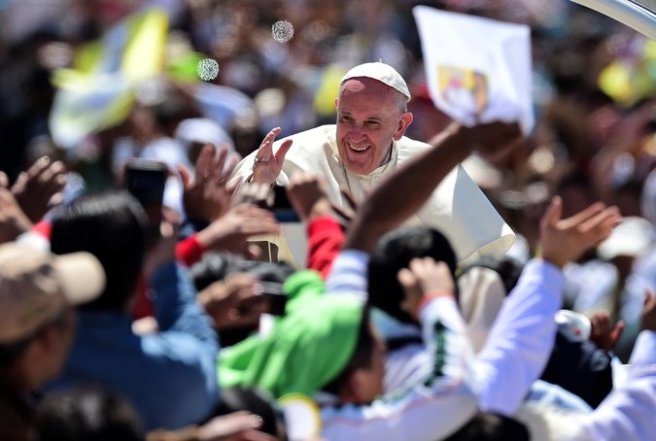
Pope Francis denouncing Presidential candidate, Donald Trump’s policies on immigration as not Christian” is a triumph for social justice. Trump’s harsh campaign promises to deport more illegal immigrants and build a wall along the border, may resonate with an angry populous. Remember, George Wallace’s line in the sand on segregation got him elected 4-times. But political rhetoric and Christianity are not the same. Trump immediately fired back that the Pope is “Disgraceful”.   I believe the opposite. Pope Francis represents— grace in action. He cares for the poor, washes the feet of prisoners and speaks out on issues of social justice.

16pope-web2-master675
Pope Francis meeting with crowds in Mexico.


No reasonable person could think hunting down and routing out Hispanics from their homes at night, loading up truck loads of Mexicans at gun point in a military maneuvers, breaking up families since children born to illegal residents in America are U. S. citizens, could be seen as Christian acts. The logistics of financing, building, and maintaining a massive wall along the Mexican border are ludicrous.

Trump is a brilliant man. He knows the challenges of putting these proposals into action. Trumpism is an effort to capitalize on the anger many Americans feel about the course of our country.

Trump
Donald Trump is a brilliant man, capitalizing on America’s fear.

This same anger was around in the early seventies with start of desegregation. Status threat is a sociological concept with real life consequences. When people’s lives are not going as they hope economically they feel threatened, angry and find someone to blame and lash out at. The targets of their anger may be minorities, homeless, refugees, but almost always the target is someone less powerful. Current economic inequalities are further complicated by global terrorism. We have become a nation of avengers, security zealots, and foreigner-phobes. Trumpism provides a constant, shrill message to rally the masses rising to a crescendo on Election Day. I am not a political forecaster. I do not know if his tactics will be successful. They have certainly gained him international attention.


I do know that Trump’s America is not one of Christ-like service to our neighbors and community. I am not a Catholic. But with the selection of Pope Francis, Christians throughout the world have had the opportunity to see God’s boots on the ground on a regular basis.

I realize now that I started this blog with the wrong question. God is always there. The right question is,  “What happens when Christians show up? The answer is miracles!


Stories of Heartbreak

I go,

you stay;

two autumns. (Buson)

 There is a story in every breakup.  Heartbreak, crushing physical pain compressing one’s chest, is a universal emotional experience. A tour last week of the award-winning Museum of Broken Relationships reminded me that even after a relationship is over the pain lives on in one’s heart. Many of us cherish the mementoes of love gone wrong reminding us of bad past choices or nurturing the fading memory of the beloved.  The museum is a touring collection of artifacts of lost relationships  Half of the display has been collected by curators Olinka Vistica and Drazen Grubisic over a 10 year period from all over the world. The other half of the display is objects submitted by individuals living in the Treasure Valley specifically for the Boise exhibition.  Amazingly, while the objects and stories vary greatly, the yearning and pain of break-up seems to be shared across time and countries. On Display February 4-March 3, 2014, Ming Studios, Boise, Idaho (mingstudios.org)Ming.jpg

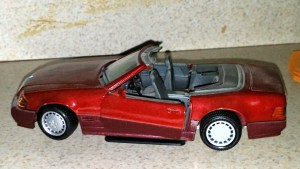
Is it really surprising in a culture that celebrates love and relationships, there is an archeology for the lovelorn?   Through romance novels, pop music, movies, and holidays we have created the fantasy that the right connection leads to bliss.  The tokens of broken relationships and their stories capture the giddy, glow of first attachment where the beloved can do no wrong. This glow can last for minutes, weeks, months or years. There are stuffed bears, Godzilla replicas, wooden soldiers, hand carved pigs, bright pink flamingos.  Little gifts given in an affectionate moment or bought on shared excursion become the symbol of the “we” in our happy prime. Notable is that the items that have the most meaning are frequently of little value except in the context of the couple’s shared experience. These small symbols capture us “falling in love” and being “love sick”.

car
Small toy car, an example of shared tokens of love with little monetary value.


When we are sick of love, we can be quite cruel in how we end it.  One young woman received a set of unattached guitar strings with the note, “No strings attached.”  Another young woman received a placeholder ring for an engagement ring.  The ring turned her finger green after a couple of weeks so she stopped wearing it.  When she tried to talk her fiancé into the real thing, he just disappeared from her life.  She kept calling him but he didn’t even have the courtesy to break up. She held on to the tarnished fake but finally felt it was time to move on, and thus, the ring became a donation to the museum.  One woman described a broken relationship with a man who in retrospect she thought was trying to kill her on a scuba diving trip.  He had taken out a life insurance policy before they left town.


One of my most embarrassing moments in college was when a boy friend, I had just broken-up with, dropped everything I had given him on the front steps of the women’s dorm. Since we had hours back then, (women had to be in at a certain time), he strategically waited until hours had come and gone. Everyone in the dorm got to witness all the strange little shared souvenirs of our time together being stacked up on the front porch.  Humiliating indeed, but a good reminder of why I didn’t want that man in my life long-term.


We tend to think of relationships largely in terms of couples, whether they be gay or straight. But the museum also chronicles broken friendships and fractured families.  I have recently had a number of conversations with friends trying to heal from lost jobs. Obviously, painful relationship can take many forms. To be human is to have a host of complex interwoven interactions. Loss of any of these intense associations may seem like the end of the world while going through the healing process.


One of the most haunting mementoes from the exhibit is a set of ear phones. There is a Dad’s message on an old telephone machine saying, “I love you, please call–beep.”  A young woman, answers back numerous times, according to the beeps with profanity and promises never to speak again.


The exhibit also narrates efforts to heal. One woman knit a sweater of everything that reminded her of her former boyfriend.  She had bought the yarn to knit the sweater while they were together, “He started talking about the ultimate sweater…I wasn’t going to begin this project until he settled on what he wanted.  He never did.”  Like the relationship the sweater is misshapen and un-wearable but hopefully the act of creation helped reduce the pain.  Another woman did a video chronicling a joyful period leading up to violence. Since she completed the video, we know she lived but we also know many do not extricate from violent relationships. When you have had an intense loving relationship with someone and end it, there is pain. While the pain heals with time, there remains as soft spot that if jarred can bring up the memories of the one lost. 

 This universality of human pain and loss is documented by Shawn Mendes in the recent hit “Stitches”

I thought that I’ve been hurt before But no one’s ever left me quite this sore Your words cut deeper than a knife Now I need someone to breathe me back to life Got a feeling that I’m going under But I know that I’ll make it out alive If I quit calling you my lover Move on…


Needle and the thread, Gotta get you out of my head Needle and the thread, Gonna wind up dead Needle and the thread, Gotta get you out of my head, get you out of my head

(Danny Parker, Teddy Geiger, 2015)