“There are two means of refuge from the misery of life — music and cats.”
― Albert Schweitzer
Albert Schweitzer and I have one thing in common, we like cats. When I am feeling down, I like to lay on my bed with Angel and listen to her purr.
Angel, our white cat, can be very comforting.
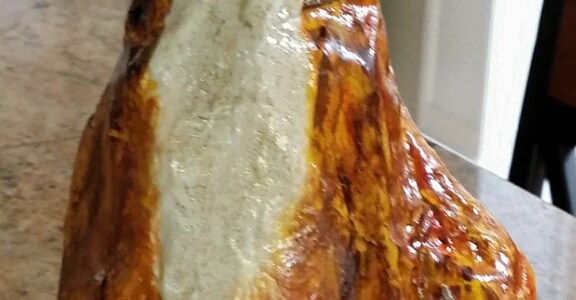
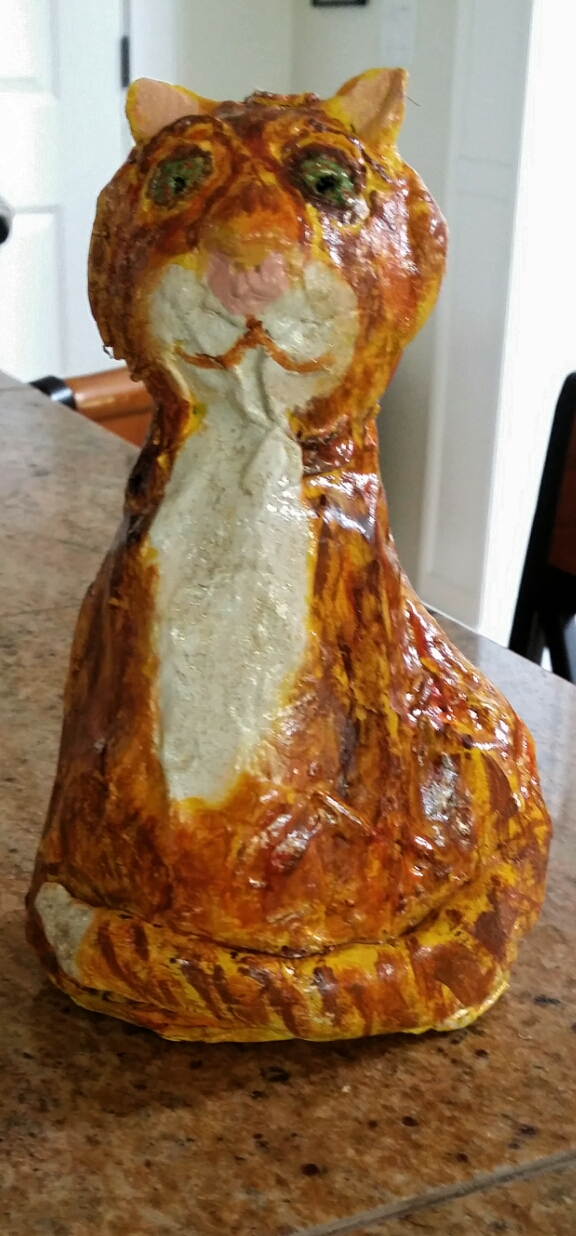
It is not surprising that when I took up paper mache, cats are the first series I worked on. The cats I have created from various materials have some connections to my past. For example, the featured orange cat reminds me of my first cat, Puddy Cat, who we got when I was in first grade. Puddy Cat lived at our family home for 21 years (far longer than I did). Paper mache, Puddy, has a body entirely of newspaper to provide structure.
Paper Mache, Puddy Cat
I wadded up paper into balls in the shape of a cat and then taped the paper in a few places to hold it together.
Brindle Cat with coat of many colors
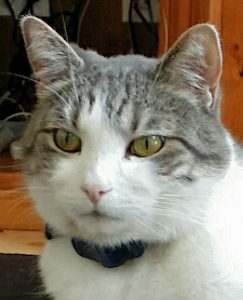
After I completed, Puddy Cat, I worked on a replica of the Satchel, the lord of the Ashtree Manor. My first effort at Satch was constructed of a toilet paper roll and Styrofoam ball for the head. There was no effort to capture the shape of a cat but rather to express the sleek, stylish nature of a cat through paper. I was pleased with the actual shape which I may try again. But the color was all wrong. I started with a black base coat and instead of creating a grey tiger stripe, I ended up with a brindle cat. I call this cat, “Cat with Coat of Many Colors”. My son told me that you always have to begin with base coat being light and then add on the darker colors later.
toliet paper roll and paper mache frameSatchel in paper macheThe extremely handsome Satchel
My next effort at Satch was a combination of experimenting with glue-based paste which creates a white clay and two toilet paper rolls. The cat structure that evolved from this effort was quite elaborate. I painted the cat all white and then layered on the various tones of gray. I am pleased with the coloring but probably won’t do such an elaborate cat structure in the future. To accurately capture Satch’s beautiful coat, I need to start with a gray base and then layer on.
I am working on paper mache prototypes because I need to have 10 items for a Christmas bazaar, a fundraiser for women’s scholarships. When I took in the cats to the planning committee, they didn’t think that cats would sell well at Christmas. I am now moving on to Christmas angels. I will blog about my angels, wood nymphs, and sprites soon.
I learned when I was visiting one of my good friends in Wyoming that she spends many hours joyfully engaged in adult coloring. She has many beautiful, brightly huged pictures she has produced. Coloring for her provides a grounding effect. Adult coloring has become very popular by providing stress relief and improved fine motor skills.
I told her I got similar joy from working on paper mache. The big different is the coloring books are easy to carry and the pens can be packed in a box. I have paper, paint, and glue strewn all over our upstairs playroom. Fortunately, the kids have outgrown the room so I can leave my objects out to dry and paint for long periods of time.
The distinction between art and craft is that art is a creation from an emotional response that cannot be replicated. Craft usually has a structure and can be replicated by others. Most of the time, I would define paper mache as a craft with structure and the ability for others to copy. However, I think in the case of my crafty kitties they are more art than craft. I will probably not make more cats but the ones I have made have reminded me of my furry feline friends.
Violet, who you have read about on these pages for many months, was stolen on Saturday, June 25 by L.C. and A.T. of Portland formerly of Sandpoint, Idaho. We know who did it because Ms. T. called our home line. We keep the line but don’t use it so did not receive the call in a timely manner. Ms. T. left a voice mail that they had found Violet a substantial distance from our home. Violet was tired and dehydrated. When my son contacted Mr. Camp, he accused us of animal cruelty for allowing Violet to be in a fenced yard, with a covered patio, loads of trees, water, and dog house. The temperature in Boise was in the high seventies at the time. She was also with her dear friend, Shani. While Violet was missing, Shani would wander the house looking for her. At night, she went into Violet’s crate searching for her.
Shani, lost without friend, searching all Violet’s haunts.
After informing me over the phone that I was an abusive pet owner and my son a potential dog killer, Mr. C. promised to take Violet to the animal shelter on Sunday morning. When we arrived in Boise from a week long trip through Wyoming, Colorado and Utah, Violet was not at the shelter Sunday afternoon. I had cried all the way through Utah because Mr. C had sent me a threatening text message telling me I did not deserve to have animals. I knew intuitively that Mr. C. would not relinquish Violet to us voluntarily.
Upon reviewing the text message, staff at the Humane Society advised us to file a theft report with the Boise Police which we did. Both Mr. C. and Ms. T. were charged with theft. The Boise police, however, would not even contact Mr. C. They left that to us to do.
My husband, being a wonderful person and concerned about my distress, did contact Mr. C who when confronted with the possibility of being charged with theft said he had left the dog at the pound. My husband went out to the Humane Society on Tuesday to verify Mr. C.’s word and once again no Violet. Late Tuesday afternoon, we received a call from the Idaho Humane Society that Violet had been dropped off. We are all so thankful!
I am of the opinion that Mr. C. and Ms. T. felt they were doing the best thing for Violet. Unfortunately, they made a series of judgments about me and my family without knowing the facts of our loving family and long-term emotional relationship with our furry friends. The only way we were able to recover Violet was by aggressive, pro-active actions on our part. Believe me, Mr. C was extremely unpleasant in all of our dealings with him. Of course, as you all know from reading these pages, to know Violet is to love her. I believe Mr. C. and Ms. T. fell under her spell and wanted to keep her.
My suggestions to all of you who have pets you love is as follows:
Make sure your pets have chips and that the chip registration is up to date. This is how we could document for the police that Violet had not been dropped off at any shelter.
Have ownership tags on your dogs collars. That is how we received the first phone call.
Update the tags if you have moved from using your land lines to using cells. This is why we gave the impression of not being concerned. We very seldom check our land line.
Be persistent. Mr. C was abusive to us but we tried a variety of approaches to getting the dog returned. We visited the Humane Society every day, contacted the Oregon Humane Society, contacted the Veterinary Association with picture and chip number.
While law enforcement won’t do much to help, having a theft report in hand does provide leverage if you follow-up with the perpetrator.
Use social media to contact friends. My son was able to identify the perpetrator on Facebook and we were able to provide the police with CHIP number, phone numbers., Facebook accounts, picture of the dog, etc.
Talking with my sister, Jane, reminded both of us what tremendous skill and love our father had for dogs
Ralph (Robbie) Robinson was a shrewd entrepreneur. At one point in time, he leased lady shoe departments from the Sweet briar and Dillard Department Store chains in Cheyenne, Casper, and Laramie Wyoming; Logan, Utah; Greeley, Colorado and Rapid City, South Dakota. He also opened a children’s department in the Cheyenne stored called Robbie ‘ s Zoo, complete with a stuffed animal zoo and six foot tall, electric, nodding giraffe under the stairs.
The majority of his career he managed the Cheyenne stores and he had two male managers in Casper and Rapid City who stayed with him his entire 30 odd years in the business. He always said the managers made the business. He closed the other stores in Utah, Laramie and Greeley finding it difficult to keep his small shoe empire profitable without key managers in place.
With the three locations, he provided us with an upper middle class life style. We belonged to the country club, owned a quarter horse, had lessons in a variety of sports, traveled a little, had cars in high school and went to a private college. My sister and I were both in college at the same time so the private school was not a small bill to pay. When I was young, I didn’t think much about money or life style. We owned a store and when extra hands were needed, for example Christmas and back-to-school we worked at the store. In retrospect, I can see that maintaining our life style through economic ups and downs was no small feat.
This blog, however, is not about dad as a business man but dad’s life as a dog trainer. Knowing his business skills and take no prisoner competitive spirit in cards and golf, it is surprising that he was an expert at training dogs.
The first dog I can remember was Hokey-Dokey, a red-gold cocker spaniel. I remember Hokey as big. Since I was 2 or 3 at the time, it occurred to me writing this blog that Hokey was probably cocker size and I was dimiutive, eye-level with the dog. Dad trained Hokey to jump through a hoop, dance on his hind legs, and sit up. Dad and Hokey would dress up in costumes. Hokey wore a tutu, and dad wore a bow tie. They would go to events to perform. I was always delighted to be included in the audience for the performance. I was in second grade when Hokey died.
Barney, the beagle, was dad’s one failure. The dog was adorable except for his baying voice and the fact that he ran away all the time, even though we had a brick fence. He would run up to my grandmother’s house three blocks away. When the animal control officer would come to her door because of a complaint, Barney woukd stick his head around grandmother’s leg and bark. Dad finally gave Barney to one of his employees.
Along the way, we had two more black cockers, one after the other. Dutchess and Princess. Dutchess was particularly adept at jumping from the ground to the saddle so she could ride on my quarter horse with me.
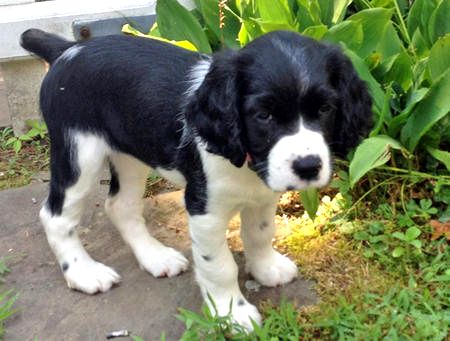
Probably the best example of dad’s dog training skill was Bumper, an extremely large, absolutely gorgeous, purebred Black and white English springer spaniel. Bumper was the last of dad’s dogs. My family home was dogless when I moved back to Cheyenne for a job after graduate school.
Bumper looked like this when I brought her home. She quickly grew to the size of a golden retriever.
I saw an animal shelter advertisement with Bumper ‘ s picture. Bumper was about six months old and had been relinquished because she was afraid of guns. My family didn’t hunt so this wasn’t a problem. I asked mom and dad if they would like the dog. I wasn’t living with them so it wouldn’t be my dog. When they said yes, I went and got them Bumper.
I am not sure it was love at first sight. Bumper had acquired some annoying habits before joining the family such as jumping up on people. She was large when I got her but she grew to be as large as a small golden retriever, way over-sized for an English springer spaniel. But Bumper certainly had her day when our family found her.
My dad trained her to walk from home to the store every day with him. She and he stopped at the post office each morning where she became well known. She stayed under his desk by his feet but would come out and greet children in the store when the sales clerks asked the kids if they would to pet a dog. Always polite when meeting children, she would sit quietly soaking in the attenton, jumping vanquished to another life time. But her greatest skill and one of my dad’s greatest joys was he trained her to carry the bank bag of deposits to the bank and stand up at the teller’s desk to deliver the cash. All the tellers’ had treats for her. She had her choice of lines. Dad and Bumper were featured in the bank’s print advertising as an example of the bank’s home-town, customer friendly service. Bumper and dad became known all over Cheyenne. They would be greeted as a team where-ever they went.
My dad retired when the Sweet briar stores went bankrupt. He was doing fine in his leased departments but had no base of operation. Fortunately, his business acumen held. He was able to support he and mom for many years on his investments. Bumper lived the life of leisure during this retirement period; going for rides, swimming for sticks in the country club lake, an activity she never tired of.
When my mom died, my dad remarried within six months to a woman who didn’t want Bumper. Dad asked me to take her. I declined because my job required a lot of travel. I had a sheltie, Ginger Rogers, who went with me everywhere. I couldn’t see taking two dogs all over Wyoming for work. With the perspective of age, I can see I could have been more flexible.At the time, I thought Dad’s new wife should have been more flexible. Family dynamics after a death with a quick remarriage are complex. Finally, Dad found a friend who was down on his luck and needed a place to live. Dad let the man stay in our family home rent free as long as he took care of the house and Bumper. Dad and I both regularly visited Bumper who seemed fine with this arrangement but I think missed her owner, my father. Bumper died two years after my mom. At that point, my dad emptied our family home (the family was now all living elsewhere) and sold it.
What did I learn from my dad about dogs. First,patience yields great rewards. Dogs love to meet their owners expectations and in turn a well-trained dog can bring joy to a family and in Bumper ‘ s case an entire community. Second, dogs are pets not children. We gave Barney away when he was disrupting our family’s life style. Dad married his new love even though she didn’t share his passion for dogs. After dad died, she got two cats whom she was fanatical about. Third,there are solutions to complex family dynamics. Bumper had a forever home because she was a great dog with a huge heart.
Hillary Clinton, 2016 Presumptive Democratic Nominee for President of the United States
Number 10:Hillary Clinton is not Donald Trump. I would support almost any reasonable candidate over Mr. Trump who continues to be a bully, racist and misogynistic. The concept of Mr. Trump as leader of the free world is terrifying. His campaign rhetoric has shown him to be a thin-skinned, unstable narcissist and a pathological liar. Since winning the primary rather than demonstrating he can be Presidential, Mr. Trump has shown a total disrespect for the U.S. Constitution’s separation of powers and continued on his path of “my way or the highway”. I deeply respect the Republicans who have refused to endorse him and publicly rebuked his commendation of Judge Curiel, the Mexican-American federal judge overseeing the Trump University law suit.
Most frightening to me is Mr. Trump’s strong support across a variety of income and educational groups in the Republican Party. The Economist in April reviewed Trump’s support and found that he has appeal to Republican voters across all income and education levels.
I have heard supporters of Mr. Sanders say they will boycott the election or write in Mr. Sanders’ name. I would argue this is a dangerous strategy. Given the sluggish economy and the fact that a Democrat has been President for two terms, past voting trends favor a Republican being elected. Mr. Sanders’ remarkable campaign and many victories have demonstrated that the future of the Democratic Party lies in a progressive agenda. We know, however, from Al Gore’s failed presidential run in 2000 that it is possible to win the popular vote and lose the election through the Electoral College. In my mind, Mr. Trump as President is too worrisome to waste a vote.
Number 9: Mrs. Clinton is a Feminine Warrior. I read recently that Hillary practices the yoga warrior pose when she is tired and needs to re-energize for an upcoming event. I was taken by the image of a strong woman rising to battle time and time again.
After more than forty years in politics and advocacy, Americans certainly know all her professional and personal baggage. We quite literally know her dirty laundry. Anyone who was an adult in the late nineties links the names Monica Lewinsky, President Bill Clinton and impeachment proceedings. Former President Clinton’s bimbo eruptions are a tawdry stain on his policy accomplishments as President. More unfathomable to me than President Clinton’s behavior, a known womanizer is Hillary’s ability to get through that dark period still married to the man and to have emerged with an amicable marriage intact.
On the professional front, Hillary has been beaten many times but she never accepts defeat. In 1993, Mrs. Clinton received a bludgeoning for her leadership on a proposed national health plan, a precursor to the arduous battle we are still fighting to provide health care to all. After a grueling primary campaign in 2008, she politely endorsed then Candidate Obama and later agreed to serve in his administration as Secretary of State. Time and time again over her political career, Mrs. Clinton has been pushed down and like a phoenix she has recreated herself and risen again, a proud, regal female warrior ready to do battle for what she believes in.
Number 8: Mrs. Clinton is fallible (and that makes her more human). As Secretary of State, Hillary Clinton took responsibility for not providing enough security in the Benghazi Attacks (September, 2012) that led to the murder of Ambassador Christopher Stevens, a friend of Clinton’s. Eleven hours of Congressional hearings on the subject never directly implicated Clinton but given her position of Secretary of State the responsibility for her staff did and should fall on her shoulders.
The Benghazi Hearings subsequently led to the investigations into Mrs. Clinton private server hosting her email account while Secretary of State. Apparently, this was common practice by other high ranking officials in other administrations. For example, Colin Powell used a similar approach to email when he served as Secretary of State. With the gift of hindsight and the Snowden (2013) leaks and numerous mass hacking of corporate accounts such as Target, the naiveté of keeping a personal server for government business seems absurd. But for those of us carrying Blackberry phones for business during this period, these choices don’t seem Machiavelli.
As recently as June 9th, 2016, the email debacle was still being raised as an election issue in Mrs. Clinton’s candidacy. Possessing the warrior spirit, Hillary politely told a reporter she would not be indicted and the email problem would not interfere with her presidential bid. She rose to the question with grace and aplomb.
To vote for Mrs. Clinton, I do not have to agree with all of her decisions or actions. I would never assume this level of support for a male candidate. I find it maddening when talking to potential voters who do not support Hillary because she is “untrustworthy”. Would they say the same about Colin Powel (a man I greatly admire) who testified that there were weapons of mass destruction in Iraq before the U.S. went to war? After all, we didn’t find any weapons but that was the opinion of experts at the time.
Mr. Trump, on the other hand, has managed to stick the moniker of “lying Hillary” on Mrs. Clinton with some ease. Yet we see Mr. Trump revising his version of the facts and his comments at almost every turn. Only recently has the media begun rapidly and accurately checking his statements. Many of which have proven to be false.
Number 7:Mrs. Clinton is a policy nerd and incrementalist. When campaigning against Mrs. Clinton, Bernie Sanders cited Hillary’s incremental approach to most policy issues as a fault. As a student of public administration, I can tell you that we are a nation of incrementalists. With few exceptions, Americans tend to respond the best and most creatively when in crisis or at war. For example, the transcontinental railroad had been stymied due to bickering in Congress on whether to follow a southern or northern route. The railroad only became possible with the succession of the southern states from the Union allowing Lincoln to authorize a northern passage. Once a decision was made, we were able to overcome all engineering stumbling blocks and become a nation united.
A less successful example of American incrementalism is health care. As a country, we implemented Social Security in response to the Great Depression. But even popular four-term President Franklin Roosevelt was unable to get universal health coverage because of opposition from Republicans, conservative Democrats and organized medicine. President Truman was the first president to strongly advocate for universal health care and his proposal was stalled in Congress. President Lyndon Johnson was successful at getting Medicare approved in 1965 (thirty years after the first discussions began).
Since then, Congress has been slowly expanding Medicare benefits including covering qualifying disabled individuals, improving quality of nursing home care, adding hospice care, drug benefits (with a donut hole) and encouraging preventive care and providing the option to purchase private insurance.
The problems of Obamacare are a direct outgrowth of our nation’s inability to implement the “Grand Idea”. Harris polling indicates that a large majority of Americans believe every American should have access to health care. Unfortunately, we are unable to agree on the details. The same poll found that 87 percent of Democrats and only 33 percent of Republicans favor a universal health care system (Harris Poll, September 8 2015).
While Americans may want to hear grand ideas in presidential debates and speeches when it comes to moving a policy agenda forward Americans proceed at a snail’s pace (thirty years to get to Medicare and almost fifty years of refinements have not resulted in full coverage for Americans). The fact that Mrs. Clinton is an incrementalist is not an indictment of her politics but rather a high compliment to her clear understanding of the difficulties of implementing policies in a large diverse nation with many viewpoints and a fractious, politically divided, stonewalling Congress.
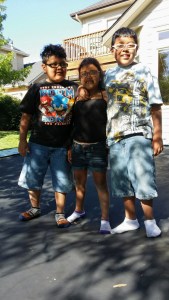
Number 6: Mrs. Clinton is inclusive. My family is inter-racial. I have an adopted daughter from China. My sister has an adopted daughter of Mexican and Native American descent. My sister’s daughter was married for a period to an undocumented Mexican man. Together they had 3 darling Hispanic children, ages 7, 8, and 9.
My niece and nephews visiting Boise from Colorado.
These children are American citizens. While my niece is now divorced, the ex still has joint custody of the children. In summary, we have a very complicated multi -cultural extended family. But we represent the future of America. We are a diverse nation and becoming more so by every day. It is our very diversity which has traditionally made us a strong country. Mrs. Clinton attracts large numbers of black and Hispanic voters because these groups see opportunities for economic and social equality consistently pushed by Mrs. Clinton. Mr. Trump, on the other hand, is interested in developing road blocks to forward mobility of all while creating a divisive culture. Other countries have discovered to their peril that exclusionary policies lead to social unrest and ethnic violence. We are already beginning to see this response by Hispanics at anti-Trump rallies.
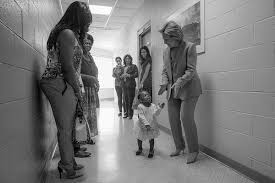
Hillary Clinton dancing with Hillary Anjoela Makabikwa an immigrant from the Congo
Number 5:Mrs. Clinton recognizes that women’s issues are family issues. The demographics of American families have been shifting for many years. The Pew Research Center (Census data 2013) has found that four in 10 American households with children under age 18 now include a single mother who is either the sole or primary of these breadwinners. The median family income for single mothers — who are more likely to be younger, black or Hispanic, and less educated — is $23,000. The transformation of black families clearly highlights the changing dynamics of American families. In 1950, 18% of black families were headed by a single woman today that number is 68% of families. This is the reality of American children, especially low income children. They are growing up in families headed by their mother with an income at or below poverty level. Federal Poverty Level (FPL) for a family of three in 2016 is $20,160.
Mrs. Clinton throughout her forty year political career has advocated for expanded, high quality day care, expansion of pre-k education, educational opportunities for women and equal pay for women. The issues on the surface appear to be “women’s issues” but with the transformation of the American family these issues are fundamental to providing a strong beginning for most of America’s children, particularly America’s low income and ethnically diverse children.
Number 4:Mrs. Clinton wants to build bridges not walls. There are two primary philosophies about how to approach U.S. foreign policy. The first is protectionism and isolationism. The second is that our community is the world and we must be strategically engaged globally. The isolationist/protectionist approach worked well for America when we were a young nation, expanding across a vast continent. But Pearl Harbor and our entry into World War II was a wake-up call that United States could not depend on the boundaries provided by the Pacific and the Atlantic Oceans for its primary protection. Our safety as a nation required that we develop strategic alliances globally. The arrival of the internet has brought further globalization. The destruction caused by 9-11 was a devastating way for Americans to learn that we sometimes harbor enemies on our own soil. We know from Orlando this week, that we continue to harbor home-grown enemies within our borders.
The choice this election is unequivocal. Mr. Trump has emphasized repeatedly his protection/isolationist approach to foreign policy. He has been clear about building a wall to keep undocumented Mexicans out of the U.S. He has suggested that entire ethnic groups such as Muslims are not welcome in our country. I believe both proposals, a wall and mass screenings, will be extremely expensive and cumbersome to implement. Assuming these polices were implemented, I’m not sure that our country will be any safer. I am sure both proposals will create further enemies both within and outside of our country. I personally do not believe that isolationism/protectionist approach is the way to keep America safe. Developing strong allies across borders and creating a global community with shared goals united against terrorism both within and outside our borders seems like a better approach to me.
Mrs. Clinton has consistently demonstrated her willingness to reach out to other nations and cultures. When Mrs. Clinton served as 67th Secretary of State, she became one of the most traveled Secretaries of State in American history. She visited 112 countries during her four-year tenure, and logged enough miles to span the globe more than 38 times.
Number 3:Mrs. Clinton has vast experience at the state and federal levels and executive and legislative branches of government. President Obama in his video endorsement of Mrs. Clinton for President said “I don’t think there’s ever been someone so qualified to hold this office.” (June 8, 2016). Need I say more?
President Obama endorsing Hillary Clinton for President
Number 2:Mrs. Clinton is a well-respected international icon. Hillary is well known throughout the world for her roles as politician, diplomat, and as an international champion for opportunities for women and girls. Her list of awards throughout her forty year career fills pages including many honorary degrees awarded worldwide. The awards vary from having a tulip created in her honor in by The Netherlands (1994) to receiving the Mother Teresa Award, the highest civilian honor given by Albania (1999) to the Chatham House Prize, Royal Institute of Internal Affairs, London (2013) for “driving a new era of diplomatic engagement and for her particular focus on promoting education and rights for women and girls.” Of particular interest to me was that Mrs. Clinton topped the list in Gallup’s most admired man and woman poll in 2015. This win was her fourteenth in a row and twentieth overall. She has held the top spot in the poll longer than other woman or man in Gallup’s history of asking the question.
Number 1:Did I mention, Mrs. Clinton just happens to be a woman.
My twenty-two year old son is home from college for the summer. He has one more semester left before he graduates and is interning at Simplot in Strategic Optimization this summer. The atmosphere in our house changes when he is home. The top 10 changes are:
Number 10: The day of arrival the front door and entry hall, approximately 12 feet square, are blocked by a 36 inch smart TV, 30 boxes of size 14 shoes (my son collects Nikes and resells them online) and numerous boxes of assorted sizes filled with who knows what.
Number 9: The second day of arrival the smart TV, playing rap music, can be heard in the entry hall through the door of my son’s second-floor room. The entry hall otherwise remains jammed with college gear. The closed bedroom door is marked Scott Kozisek, Please Knock.
Number 8: By the end of the first week home, the entry way is empty except for a large backpack propped against the wall and camel pack, laying on the steps, both will probably remain there all summer. My son’s possessions are now leaching out of his bedroom filling up the 12 by 12 landing at the top of the stairs and hindering access to the playroom.
Number 7: Household dynamics are slightly off kilter, like falling down the proverbial rabbit hole. My son is a vegetarian, a dozen eggs last three days instead of a week. Grocery shopping is expanded to include tofu, dozens of eggs, chocolate milk,whey protein. Our three car garage is challenged to provide parking for our fleet of four cars, juggling cars and keys is now the norm. Beautiful sound systems up and down stairs play competing music with jazz, James Taylor, and Carole King dominating downstairs and hip/hop, rap, and electric dance music echoing through the upstairs.
Number 6: I hear the front door opening and closing at 2:30 or 3 a.m. on Friday and Saturday nights. Or I don’t hear anything and get a text in the morning about crashing at friends. I have to continually remind myself that my son is an adult and can make his own choices. My tongue aches as I bite it to keep from saying something that I may regret or may damage our relationship.
Number 5: The dogs, Shani and Violet, whine and beg to get out of my office where I am watching TV or working on the computer whenever their hero, my son, comes in the back door. This adoration for the lost boy is somewhat annoying since I continue to do all the feeding of the pets.
Number 4: I hear shouting at 11 p.m. between my daughter’s and my son’s bedrooms about a large bug that must be removed from my daughter’s ceiling fan. My son’s removal efforts result in random dust explosion and the bug being knocked off the fan onto my daughter’s bed. More shouting erupts when the bug in a remarkable rebound returns to the fan. Using my daughter’s belt, the bug is exterminated by my son. Because my daughter is unwilling to touch such an ugly thing, my son must extricate the insect from the down comforter. Placing the bug in the trash will not do. It must be flushed down the toilet to ensure the room has been de-bugged. I hear the vacuum turn on. I go upstairs to investigate. My daughter is vacuuming her bed, guaranteeing no other bugs have lived through the dust bowl event and removing the remaining dust mites from her quilt. Interactions of this nature will ensue throughout the summer, when previously the upper floor was silent.
Number 3: The amount and quality of conversation at the dinner table has increased geometrically with the addition of a third adult. We have moved from discussing high school and the weekly schedule ( who is going to be where and when) to discussing politics (no one in our family likes Trump though there is division on which Democrat to support), upcoming music and events in Boise, hit summer movies (who has seen what and who wants to go to what) and weekly schedule (who is going to be where and when). We managed to coordinate well enough at dinner to allow us all to see Captain America Civil Wartogether the first week it was out. A good movie for families with kids 13 and up. We have also managed to schedule our Father’s Day Celebration for Wednesday, June 15th attending Alive After Five. That was the closest date, we could find when we were all in town. Kayla has a particularly busy summer traveling to camps and mission work all over the country.
Number 2: I have someone to watch streaming of Dare Devil, Season 3 on Netflix late at night. We are moving on to Jessica Jones. My son is watching the third season of Peaky Blinders, his favorite show. I watched my first episode this week. Peaky Blinders received a rave review in the Wall Street Journal as a fabulous period piece. Focused on Irish gangs in London after WWI, the episode I watched was bloody but haunting. My daughter by comparison and I watch Bones, America’s Got Talent, Kids’ Baking Championship and Chopped.
Number 1: I get regular hugs for making coffee in the morning and for packing lunches to send out the door to work.
The Essence of Art: man’s selective re-creation of reality(Ayn Rand)
Creating is in our DNA. The earliest documented art, found in Indonesia, are carvings in a shell with a shark’s tooth dating back 540,000 years (pre Homo sapiens). Just this week, scientists in France dated elaborate stalagmite structures in a cave underground back to those supposed stupid, rude and untalented Neanderthals thriving over 150,000 years ago.
Pottery, objects made from fired clay, are the first synthetic objects made by humans. Since clay is found throughout the world, a variety of objects from many places have been found dating about 30,000 years ago. Relatively, new in the scope of world affairs.
Man started making pottery when we evolved from a hunting and gathering into agricultural societies. That makes perfect sense to me. Nomads chasing wildebeests with rough edged arrow heads, hand-carved from rock, would probably not be inclined to haul a lot of earthenware around with them. Crockery, the growing of grain, and cooking seem to all go together not only in man’s development but in my sense of the history.
Pablo Picasso once said, “Every child is an artist. The problem is how to remain an artist once he grows up”. Since I retired in November, I have been awaking the inner child artist in me. As regular readers of this blog know, several weeks back I have been busy with papier-mâché (see https://wordpress.com/post/julierobinsonblog.com/2549 ). Starting in March, I took an 8-week beginning pottery class at our local community center. The class met every Wednesday for three and half hours. There were ten of us in the class. Most were seniors though we had one very talented younger woman, who had moved to Boise a year ago, and two young disabled male adults. Several of the retired women had taken the beginner class previously and worked on their own projects instead of following the prescribed class instructions.
Our instructor, Chris, is coordinator of the arts at the community center. He is Irish with bright red hair, a quick smile, great patience and kindness. He holds a degree in fine arts from Boise State and is a master potter, known in the region for some of his works. He told us he couldn’t imagine getting through college until he discovered pottery in high school.
Our class began with learning how to throw pots on the wheel. I found I was not good on the wheel. My legs would shake and subsequently my hands, braced on my legs couldn’t find “center”. “Center” is a key beginning point of pulling a beautiful tall pot. As a beginning class, most the wheel-thrown pots stayed at 4 or 5 inches and were shaped largely like coffee mugs. But my pots were only about an inch and that was after great help from Chris. I couldn’t find one of my pots to glaze but the one I did is glazed in my favorite blue.
Scott, my son, says it looks like an ash tray. But I’m using it on my dressing table to hold earrings. I love the color.
One of my thrown pots started to go off kilter. At about this time, Chris told us to start using our imagination to make our pots more whimsical. He meant different heights and designs on the wheel. But I took his directions to be an invitation to move into fantasy land. I pulled my thrown pot further off center. I subsequently marked up the skin of the pot with wood imprints. Once stained brown and green, I think of it as my “tree trunk” entry into Neverland and the lost boys.
I found I was in my element working with slabs of clay. The slabs are made by kneading the clay into bricks and then pulling the squares through a roller. The resulting slab is about ¼ inch thick when appropriately rolled. Our first slab assignment was a box with a lid.
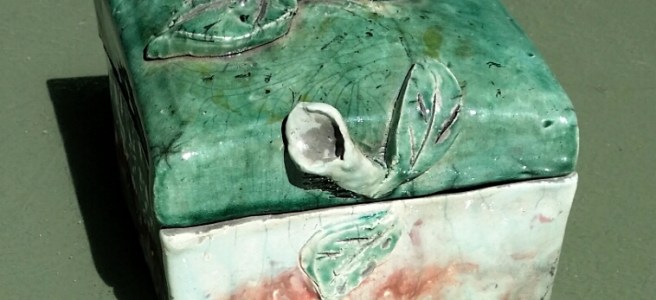
The box is made by careful measuring, cutting with an exacto knife, piecing together the parts and then hitting the clay with flat wooden spatula to solidify the form for firing. My box has a Daisy on top. I had a grandmother named Daisy and my niece is named Daisy. The Daisy is also the symbol of PEO, a philanthropic organization that provides scholarships to women. My sister is the current state president of, Idaho PEO, an organization of over 3000 women. My mother was the state president of PEO in Wyoming when I was in high school. On the front is a white calla lily. My daughter, Kayla, is named after the calla lily which grows wild in China and Idaho (see https://wordpress.com/post/julierobinsonblog.com/1742).
I have my box sitting above my computer in my office, a reminder of how many strong women have supported me in my life. The colors are a little too greenish for my taste but this is the result of limited choices for our first glazing experience. We had a choice of two whites, a non-shiny copper and the green iridescent. I have learned while watching others glazing in class, glaze is not a precise science. One has to put on the glaze and wait to see what emerges from the interaction of fire and paint.
My final product and probably my artistically best object is a pinch pot. The pinch pot is made by taking a clay in the shape and size of a baseball and slowly pinching it into a pot. As the class went on, we all became more experimental and creative. I created stripes and circles on the pot with waxed paper coated on back with a sticky substance. Areas covered with paper when dipped in the first glaze could be left to turn black, the result of no glaze. This can be seen on the black areas of the daisy and calla lily on the box. I chose to pull off the paper and dip my pot again in the white bubble glaze. This glaze provides texture and resulted in the copper accents where previously I had paper strips. I have this pot proudly displayed in my living room on our bookcase of art objects. It seems to fit right in.
A number of my classmates chose to enroll in another class right away. I love the summers in Boise and would prefer to be outside rather than in a class room. After eight weeks, I picked up my tools, my pots, and donated my left-over clay to the community center.
I may choose to take the beginning class again in the fall or winter. If I choose to take it again, I will focus on the areas that gave me the most joy, i.e. the hand-crafted items. By taking the beginning class and trying both throwing pots on the wheel and creating free-form, I have much more respect for the technical skill necessary to throw a gorgeous pot.
Our instructor, Chris would tell us to listen to the clay and then your art will emerge. He cautioned us against starting with a preconceived idea of where to end up. Using this approach, I created an entrance to Neverland, a strong women’s box, and pinch pot dipped in the glaze called pond scum. I found as Pablo Picasso advised my inner artist.
My family and I have travelled to the Orient, Europe, England, Ireland, Scotland, Mexico, Canada, Alaska, Hawaii and extensively in the U.S. Our number one rule is that you have to pack so you can carry all your gear on the plane. I have traditionally carried everything I need for up to ten days in a roller bag meeting airline carry-on regulations, a backpack and a fanny pack. I strap the fanny pack to my waist with my phone, money, and passport and only take it off at night to make sure my valuables and I are never separated. In a pinch, I can get the fanny pack into the backpack so I meet the two bag requirement of the airlines.
My two kids have been responsible for pulling their suitcases and carrying their back packs since they were old enough to travel. Fortunately, bags and backpacks come child- sized. Kids don’t bring many clothes. The ones they bring are tiny. When the kids where younger, their clothes went in the roller bags and their backpacks were full of entertaining objects such as coloring tools, paper, Gameboys, and playing cards. All of this has become passé with the advent of smart phones and iPods which entertain my children for hours. I see very young children playing with in airports now.
We made the decision to wean down our wardrobes and keep our luggage with us because of lost luggage leading to problems at our destination. Now we travel with our luggage to assist in making connections if we have to change itineraries, reducing the problems of dealing with lost luggage and trying to keep the price of travel down. Taking four us to Spain or Hawaii and paying luggage fees for everyone becomes extremely costly.
Recently, I have become the drag on our traveling caravan. I have a very rare neurological disorder. I can walk just fine (for which I am very thankful). But I can’t stand for any period of time without my legs starting to shake. At the same time the lines for airport security are growing, my ability to stand is diminishing.
When my son and I travelled from Florida to Boise in March, I had trouble at the Pensacola, Florida security check. We had waited a long time. I told the screeners I had trouble standing but I couldn’t get them to listen. When I walked through the scanner, the equipment showed me carrying weapons all over my body i.e. in my arm pits, waist band, bra, anywhere that moved as my legs shook. After a humiliating body check, I complained to the supervisor who said I should have told the initial TSA worker. I had, of course, done this. In fact, I had told two workers but they were too busy to listen. Given this experience, I decided I needed to take matters into my own hands.
Flying home from Seattle a month ago, I received a text from Alaska Air that the lines at Seattle International Airport were two hours long. I asked for a wheel chair when I got to the airport. Once in the wheel chair, we zoomed right through the crowd. However, I was physically in better shape than the kind woman pushing the chair. As soon as I got into the boarding area, I was up walking around. I felt uncomfortable being pushed around when I’m perfectly capable of walking. Given the Florida and Seattle experience, I have done two things that I hope will improve my air traveling experiences.
The first is that I am now on the TSA priority boarding list. For a long time, I routinely got priority boarding but recently I have not. I am obviously not in a position to hope for the luck of the draw. I paid the $80 and scheduled the time to be fingerprinted. The next time I fly, I will enter my number TSA number and be able to skip the longer screening lines.
The second thing I have down is purchase the Jurni, a bag designed to be a carry-on but also to sit on (https://www.indiegogo.com/projects/jurni-the-ultimate-sit-on-carry-on-suitcase#/) My daughter, Kayla, found the bag online when the luggage was still only a concept on a go fund me page. If you put in the funds to help develop the proto type, you got the bag when they were ready to be shipped.
My bag arrived this week. As promised, I can pull it easily behind me and sit in it like a horse and scoot around the house. Now, rolling around a crowded airport may be a different thing altogether. Sitting on it like a chair is tipsy. I feel like I’m riding a rocky boat or I had too much to drink, a disconcerting feeling and the wheels can go out from under you throwing you to the floor. Thus, the bull rider approach with my legs anchored around the Jurni, I am in control of its movements for short distances. In other words, I would propel me along in a line.
Jurni, handle extended
Ride’em Bronco
The bag is tiny. I can see why it is designed for teenagers. My 16 year old daughter wears an extra small in most clothes and a size 0 in jeans. Until Kayla grew into these sizes, I actually thought they were pretend sizes to finish off the clothes rack. I remember standing in the Abercombie store when she shouted over the dressing room divider that the zero was too big and she needed a double zero. Really, a double zero! I wasn’t that small in grade school. Kayla could easily put a week’s worth of clothes into the little compartment designed for clothing.
I am not Kayla. While I am not enormous, I have grown heavier with age. The possessions I notice that now take up the most room are my bras which have grown geometrically since giving birth and breast feeding. The movement up to a D was bad enough but now on the downward slippery slope of aging, my circumstance is 2 inches bigger and I need wire armor to keep my cascading physique in place. The same is true of my swimming suit which used to be teenie weenie but now takes up the space of a small sea monster in order to pull me in all the right places and hold up those previously mentioned descending upper body parts. Deciding what to take and purchasing travel clothes that meet all your needs while fitting everything in small compartments takes significant planning. My first thought when I looked in the Jurni was I was going to need to work on loosing more weight and buying a new smaller traveling wardrobe (double zero, here I come!)
The good news is that the Jurni knows it’s packing compartment is tiny and for an extra cost has included zip bags to scrunch all my jumbo items into the size of my daughter’s size small. I tested the feasibility of utilizing the Jurni for a real trip rather than riding around my living room by laying out the wardrode I took to Mexico in January and seeing if I could fit it in the case. Much to my amazement, I got 3 pairs of long pants, 3 long sleeved shirts, 4 short sleeved shirts, 2 pairs of shorts, the iron maiden bra and sea monster swimming suit plus rash guard jacket, my traveling pjs (light weight), my wash out panties (3 pairs) seven pairs of white cotton socks ( I always wear socks with my hiking shoes) and a pair of flip-flops. I actually called them thongs (my daughter was horrified). Appparently, thongs were shoe wear in the seventies but are strickly underwear in the twenty first century.
Empty bag
Packed zipper bags
Jurni, fully loaded
Clothes for Mexico laid out
The little plastic buttons on the Jurni that serve as openers seemed a little stressed by my wardrobe. I am now on the look-out for a band to go around the Jurni once packed. The company sells a check-in strap and lock. But the strap goes from top to bottom and prevents you from utilizing the pull up handle. I would also be sitting on the buckle which seems weird to me. I want something that goes around the middle, doesn’t interfere with the handle but guarantees that the iron woman underwear is not strewn all over the run way as I board a miniscule Alaska Airline plane where all carryons are actually always loaded under the plane.
I can’t provide a full evaluation of the campabilities of the Jurni until it actually goes with me on a journey. That may be a few months off. After jaunting all over the world and the U.S. the past few months, we are spending our summer in the Mountain West. Afterall, why go any place else when you are already there.
The Kayla (Calla) lily we planted in our garden in honor of our daughter from China is flourishing. The blog about Kayla and her flower can be found at https://wordpress.com/post/julierobinsonblog.com What’s in a name?
Recently, I joined a women’s organization that hosts an annual Christmas bazaar to raise funds for education. We are all supposed to make something to sell. I was born with very few arts and craft genes. Since the first recorded cave art is over 500,000 years old, some of our early ancestors definitely had these genes and passed them on to a few lucky souls. You and I all know the person who shows up and can fashion a felt hat from a knit sweater or a gorgeous quilt from a rag bag, or takes home the hodge podge of objects contributed by parents to the school auction and produces a world class auction basket. I stand in awe of these people. I am not one of these people.
My freshman year in college, I took up knitting. I made dozens of extremely-long, odd- shaped scarves using the basic knit one/pearl one stitches. Everyone I knew ended up with one of these slinky reptilian beasts. As a child, my mother did her best to endow me with some homemaking skills. I was enrolled in 4-H for a few years. I turned out passable aprons and gathered skirts, resulting in blue, red and white ribbons at fair. My muffins had tunnels, little holes made by too much air–no ribbon at the county fair. I did win the purple ribbon and best in class, one year for my meal plan. In retrospect, this award is extremely ironic because I don’t cook much at all.
While suffering angst over the bazaar challenge, my sister, Jane, reminded me that as a child, I was a whiz at paper mache. My skill wasn’t because I wanted to produce great art. I was fascinated by puppetry. I’d make a variety of puppet heads with died cotton ball hair and whip up their outfits on our sewing machine. Then I would write elaborate plays for my friends and I to produce.
My first thought was there wasn’t much interest in paper mache anymore. I couldn’t have been more mistaken. When I looked up a paper mache refresher course on YouTube (source of all things educational),one sweet-looking elderly lady, Joni Good at http://www.ultimatepapermache.com has a blog, numerous books and dozens of YouTubes. Her recipe for paste has over a quarter of a million views. A second teenage girl has over 200,000 views demonstrating Joni’s recipe. One man has over two million views on how to make a piñata. An attractive lady making a paper mache bowl has over 1 million views.
Apparently, there are a lot folks out there making craft items out of paper and paste. My sixteen year old daughter, Kayla, says there are just lots of people who like to watch YouTube and aren’t making anything. Surely these high numbers of viewers reflect some papery product being produced somewhere and not just viral surfers and paper stalkers. Given this huge viewing volume, I thought why not give it a try again? After all in the scope of human affairs (homo sapiens as we know them have been around for more than 200,000 years), 52 years of not touching anything related to paper mache isn’t that long a time.
Paper mache originated in China during the Han Dynasty (BC 202 to 220). The Chinese made paper mache helmets that they hardened with lacquer. From China, the craft spread to Japan and Persia. Those elaborate oriental masks, you see when you travel are paper mache. When the art of paper mache reached France, the French, always unique, decided to create their art by chewing up the scraps of paper. Chewing paper would, of course, give you small pieces of sticky, damp paper to work with but sounds disgusting to me. When I began my paper mache project, I rejected the French approach and used the yellow pages approach, “let your fingers do the shredding”.
After reviewing some of the videos on new approaches to paste (joint compound, linseed oil, and Elmer’s glue), I elected to go traditional. My first project is made of paste from flour, salt and water (recipe below). A an empty toilet paper roll and Styrofoam round ball provided the infra structure. I used newspaper for the coating. Using household products did result in the bumps in odd places that led Joni Good to make up a more elaborate paste recipe. But I am still taken with the more modest approach to paper mache because as a child, I remember we could just go to the kitchen, whip up paste without the hassle of gathering together a lot special stuff and have our theater cast underway in no time. I think there is something to be said about being able to create when the urge strikes you, especially when children are involved. In addition, the flour and water is easy to clean up with soap and water, inexpensive and very forgiving when you make errors. Finally, it is not fast drying—a plus for joint compound and glue but a negative if you want to rip off some error you have made.
I am also taking a pottery class. In pottery, our teacher is always telling us that the clay speaks to us. I was originally going to make a reindeer (remember this project started for the Christmas bazaar in 9 months). When I got started on the reindeer, he morphed into a beagle.
Barney, before he got a coat of varnish, eyes and collar
I am very familiar with beagles, we had one when I was child. For those art critics out there, I know the snout on my paper beagle is too long and his feet too big (blame the reindeer). My sister, Jane, and I called our beagle, Barney the Beagle with the goo-goo-googlie eyes. The entire time I was crafting my paper dog, I was thinking about Barney. As you can see, Barney the Beagle has goo-goo-googlie eyes.
Barney was finished off with acrylic paints, spray-on shiny varnish, and repurposed eyes, nose and tongue from the reindeer I was trying to clone. I found an unused cat harness in my pet drawer. Any of you, who have read my blogs on my pets know that Satchel, the big gray Tom Cat wouldn’t be caught dead in a whoosie harness (one has to question my sanity for buying it at some point in time). I cut up the offending harness and made a realistic collar for Barney. Satchel was pleased.
I am proud of Barney for a first effort.
Barney, with the goo, goo, googlie eyes!
He obviously isn’t good enough to sell at a bazaar, too many nasty little dings and bumps. But he is good enough to give to my husband, Pete, for Father’s Day. Pete has an office full of items the kids and I have made and seems delighted with whatever we give him no matter how low quality.
I have roughed out an angel and cat to see if I can’t still produce something that someone might buy. I may try the joint compound bending to the will of the masses to have a saleable product. Also from my pottery instructor, art takes time and patience. I have nine months but at my age I’m not sure I will every produce a financially viable product. That’s the beauty of paper mache. There isn’t much of an investment if the outcome is poor and you can also toss it in the recycling bin.



























 My Private Idaho