
Papier Mache: French for chewed paper
Recently, I joined a women’s organization that hosts an annual Christmas bazaar to raise funds for education. We are all supposed to make something to sell. I was born with very few arts and craft genes. Since the first recorded cave art is over 500,000 years old, some of our early ancestors definitely had these genes and passed them on to a few lucky souls. You and I all know the person who shows up and can fashion a felt hat from a knit sweater or a gorgeous quilt from a rag bag, or takes home the hodge podge of objects contributed by parents to the school auction and produces a world class auction basket. I stand in awe of these people. I am not one of these people.
My freshman year in college, I took up knitting. I made dozens of extremely-long, odd- shaped scarves using the basic knit one/pearl one stitches. Everyone I knew ended up with one of these slinky reptilian beasts. As a child, my mother did her best to endow me with some homemaking skills. I was enrolled in 4-H for a few years. I turned out passable aprons and gathered skirts, resulting in blue, red and white ribbons at fair. My muffins had tunnels, little holes made by too much air–no ribbon at the county fair. I did win the purple ribbon and best in class, one year for my meal plan. In retrospect, this award is extremely ironic because I don’t cook much at all.
While suffering angst over the bazaar challenge, my sister, Jane, reminded me that as a child, I was a whiz at paper mache. My skill wasn’t because I wanted to produce great art. I was fascinated by puppetry. I’d make a variety of puppet heads with died cotton ball hair and whip up their outfits on our sewing machine. Then I would write elaborate plays for my friends and I to produce.
My first thought was there wasn’t much interest in paper mache anymore. I couldn’t have been more mistaken. When I looked up a paper mache refresher course on YouTube (source of all things educational),one sweet-looking elderly lady, Joni Good at http://www.ultimatepapermache.com has a blog, numerous books and dozens of YouTubes. Her recipe for paste has over a quarter of a million views. A second teenage girl has over 200,000 views demonstrating Joni’s recipe. One man has over two million views on how to make a piñata. An attractive lady making a paper mache bowl has over 1 million views.
Apparently, there are a lot folks out there making craft items out of paper and paste. My sixteen year old daughter, Kayla, says there are just lots of people who like to watch YouTube and aren’t making anything. Surely these high numbers of viewers reflect some papery product being produced somewhere and not just viral surfers and paper stalkers. Given this huge viewing volume, I thought why not give it a try again? After all in the scope of human affairs (homo sapiens as we know them have been around for more than 200,000 years), 52 years of not touching anything related to paper mache isn’t that long a time.
Paper mache originated in China during the Han Dynasty (BC 202 to 220). The Chinese made paper mache helmets that they hardened with lacquer. From China, the craft spread to Japan and Persia. Those elaborate oriental masks, you see when you travel are paper mache. When the art of paper mache reached France, the French, always unique, decided to create their art by chewing up the scraps of paper. Chewing paper would, of course, give you small pieces of sticky, damp paper to work with but sounds disgusting to me. When I began my paper mache project, I rejected the French approach and used the yellow pages approach, “let your fingers do the shredding”.
After reviewing some of the videos on new approaches to paste (joint compound, linseed oil, and Elmer’s glue), I elected to go traditional. My first project is made of paste from flour, salt and water (recipe below). A an empty toilet paper roll and Styrofoam round ball provided the infra structure. I used newspaper for the coating. Using household products did result in the bumps in odd places that led Joni Good to make up a more elaborate paste recipe. But I am still taken with the more modest approach to paper mache because as a child, I remember we could just go to the kitchen, whip up paste without the hassle of gathering together a lot special stuff and have our theater cast underway in no time. I think there is something to be said about being able to create when the urge strikes you, especially when children are involved. In addition, the flour and water is easy to clean up with soap and water, inexpensive and very forgiving when you make errors. Finally, it is not fast drying—a plus for joint compound and glue but a negative if you want to rip off some error you have made.
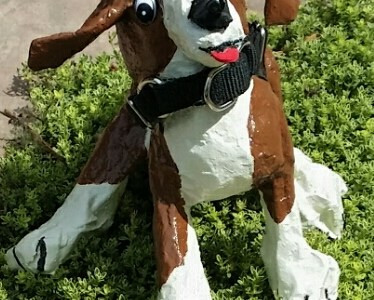
I am also taking a pottery class. In pottery, our teacher is always telling us that the clay speaks to us. I was originally going to make a reindeer (remember this project started for the Christmas bazaar in 9 months). When I got started on the reindeer, he morphed into a beagle.

I am very familiar with beagles, we had one when I was child. For those art critics out there, I know the snout on my paper beagle is too long and his feet too big (blame the reindeer). My sister, Jane, and I called our beagle, Barney the Beagle with the goo-goo-googlie eyes. The entire time I was crafting my paper dog, I was thinking about Barney. As you can see, Barney the Beagle has goo-goo-googlie eyes.
Barney was finished off with acrylic paints, spray-on shiny varnish, and repurposed eyes, nose and tongue from the reindeer I was trying to clone. I found an unused cat harness in my pet drawer. Any of you, who have read my blogs on my pets know that Satchel, the big gray Tom Cat wouldn’t be caught dead in a whoosie harness (one has to question my sanity for buying it at some point in time). I cut up the offending harness and made a realistic collar for Barney. Satchel was pleased.
I am proud of Barney for a first effort.

He obviously isn’t good enough to sell at a bazaar, too many nasty little dings and bumps. But he is good enough to give to my husband, Pete, for Father’s Day. Pete has an office full of items the kids and I have made and seems delighted with whatever we give him no matter how low quality.
I have roughed out an angel and cat to see if I can’t still produce something that someone might buy. I may try the joint compound bending to the will of the masses to have a saleable product. Also from my pottery instructor, art takes time and patience. I have nine months but at my age I’m not sure I will every produce a financially viable product. That’s the beauty of paper mache. There isn’t much of an investment if the outcome is poor and you can also toss it in the recycling bin.
Simple Paper Mache Paste Recipe
1 cup flour
1 cup water
3 teaspoons salt
Mix together and start gluing
Most important–Have Fun!





 My Private Idaho