Man Bun vs. Mom Bun


20160809_164000
Our competing Muns at the breakfast bar

My son Scott headed out for his last fall at the University of Idaho this week. He is President of his fraternity, Phi Kappa Tau and had to be at U of I early to get the fraternity  house ready for Rush.  Before he left he took time for our Man Bun versus Mom Bun (MUNs) head shots.

The family teased him all summer for his long hair on top, cropped short on sides.

20160809_164211
Scott’s hair , looking great!

His hair looks great for work but for lacrosse or workouts flops down his face in a long veil unless it is held back by a bun and sometimes bun and headband. When he has his hair up, he is part of the man bun crowd started a few years back by hipsters in New York, moving to San Francisco and becoming popularized by  celebrities Jaquin Phoenix, Jared Leta, Harry Styles, Zayn Malik. (both of One Direction, boy band fame).

MUNs are popular enough now that you can purchase one on Amazon.com if you don’t have enough hair.  Nick Cannon has been wearing  a  MUN the last few weeks on America’s Got Talent.  Mr. Cannon told folks on Good Morning America that it takes a couple of hours to get his corn rows and man bun in place.  Man buns aren’t for everyone. Since many men have a hereditary tendancy to loose their hair as they age, there have been recent cautions that wearing a too-tight man bun can pull out your hair permanently, prematurely.  Scott doesn’t have to worry about that. The hair loss gene comes from the mother’s side of the family.  My dad had fabulous wavy hair until he died.  The popularity of the man bun has moved it into the realm of humor.  If you want to see  politicians with man buns including Donald Trump check out this link: http://twistedsifter.com/2015/11/if-politicians-had-man-buns/

My hair is a different story.  By the time I hit thirty, I was in professional jobs and kept my hair short to ensure  I had some semblance of a coiffeur at work.  Before short hair, I had extremely thick, long, and amazingly unruly hair.  In my late twenties when I had long hair and  was at a meeting of all men, I turned my head and a rocket shot across the room.  Everyone in the room asked what it was.  When we finally rescued the flying object from under a table across the way from me, it turned out to be an electric roller caught under my very thick mane, left in-place unnoticed as I hurried out the door to work.  Turning my head displaced it and propelled it across the board room.  Since the late seventies were a time when women were just clawing their way into management positions, it was essential that I look as prim and polished as possible.  I challenge you to  remain dignified when claiming a sailing roller from your supervisor at a major meeting.  The roller incident was the beginning of my many efforts to tame my wild mane by keeping it short.

By my early thirties, I was starting to get premature white hair.  Both my mother and grandfather had gorgeous white hair by 35 but  I chose to color my hair to be in step with the times.  I have now been coloring my hair for almost 35 years.  I actually have no idea what color my hair is now.  I thought about letting it grow gray when I retired but decided to wait to see my true color until my daughter Kayla is out of high school.

I started growing my hair the day I retired.  My hair is now down to my shoulders but hard to pull up into a bun.  It takes two small buns to make one.  My hair is long enough to whip around in the Wyoming wind on vacation.  I love the freedom of feeling my hair blow when we are out on our bikes or on a boat.  I have also gotten my hair long enough that my daughter can braid it though it ends up with a little tiny pig tail rather than an long beautiful streamer.  I plan on growing my hair to about the length of Meryl’s Streep’s hair at the Democratic convention, slightly below my shoulders.   The ability to grow my hair and let it do as it pleases in retirement has been a great joy.

I miss my son already though he has only been gone a couple of days.  I have no competition now in the MUN contest.  When he is around the house, there are moments every day of great laughter about silly things.  University of Idaho you are lucky to have him this fall and I was fortunate indeed to spend the summer growing my hair along with him.



Malleable Barbie Adapts to the Times

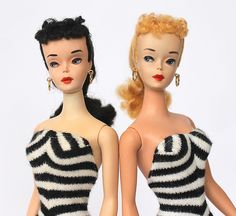
1959 Barbies
1959 Barbie.  An icon for 57 years of America’s focus on women’s breasts and looks, over achievements

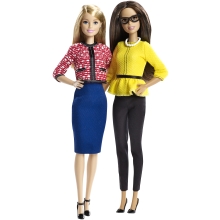
First introduced in 1959, over the past 57 years, Mattel has tried to update Barbie to adjust to the times. To that end, the company introduced last week, Barbie for President with a female running mate. This combination is intended to be an inspiration for young girls. “By introducing the new President and Vice President Barbie dolls, the first all-female ticket, we hope to inspire girls to imagine themselves as leaders,” Erin Loos Cutraro, co-founder and CEO of She Should Run, tells Babble.

Throughout her life-span, Barbie has become ethnically diverse, moved from a beauty queen  and model to a professional.  Her hair originally a classic long pony tail which couldn’t be combed has transformed to long, short, curly, black, red, blonde, silky and brushable to totally changeable. Barbie’s  originally stiff body is now flexible.

But one thing that has not changed is her shape.  Research suggests that a real woman with Barbie’s figure would be 5’9″,  host  a 39 inch bust, 17 inch waist and wear a size 3 shoe. Given the wildly disproportionate trunk to base,  a real woman with this shape couldn’t walk, would have extremely frail bones, half a liver and probably be anorexic. Mattel is currently working on changing Barbie again by incorporating more diverse body types, though the exact nature of these changes has yet to be specified.

Rather than  launching a new wave of socially engaged little girls, Presidential Barbie seems antiquated.  This is particularly true when viewed in combination with Jennifer Aniston’s For The Record in the Huffington Post (7/12/2016 ).  Aniston writes about unwanted speculation from the media and complains about the objectification of her body in particular and women’s bodies in general.  Given these two pieces of evidence,  it appears  Americans have not progressed very far in their expectations of what an attractive young woman should look like.

I am left in a quandary about what American cultural expectations do to little girls self image.  We are pushing young girls in to pursue STEM programs (we want girls to go into math, science and engineering).  Women’s sports are on the rise with girls participating in every imaginable activity.  Cheerleading is still around but not the sole way for a teenage girl to be involved in a sporting event.  Yet with all these changes, Aniston writes just this week  The objectification and scrutiny we put women through is absurd and disturbing. The way I am portrayed by the media is simply a reflection of how we see and portray women in general, measured against some warped standard of beauty”. 

pMAT1-24394475reg
President Barbie and her female running mate continue the oddly proportioned Barbie shape.

I would argue the newly released presidential Barbie doesn’t encourage young women to be whoever they want but rather reinforces strongly held  cultural beliefs that attractive women sport large breasts, narrow waists and are stilted rather than engaged in life.  These icons of American woman have fabulous hair styles and always dress correctly.

The Republican and Democratic conventions are rolling into our media space the next two weeks.  Speaking only last night, we learned within minutes of  Melania Trump’s presentation that she wore an off-the-rack white Roksanda dress costing between $1500 and $2000. The dress was described as “perfect for the White House.”  I am willing to bet we  will read about Tiffany and  Ivanka Trumps’outfits as well i.e. who designed it, cost and whether the dress looked appropriate for the setting.  All three women are drop-dead gorgeous so I can’t image any tacky comments about hair or appearance.  I doubt we will read anything about Marco Rubio’s, Newt Gingrich’s or Donald Trump’s suits (what they cost and what fabric they were made of, how did the tie go, did they get wrinkled or hang perfectly on TV).

While snide comments are frequently made about Donald Trump’s hair, these remarks don’t seem to have any traction. In comparison, an article about Hilary Clinton wearing an Armani suit went viral.  Mr. Trump’s suits routinely cost at least $7,000 but this does not seem to be of interest to the American public.  Sara Palin had a budget of $150,000 to purchase clothing for her Vice Presidential run.  Demonstrating that focusing on the importance of women’s appearance  rather than just judging individuals based on competence is not limited to party but rather to gender.

Michelle Obama has made being a Presidential wife or candidate accessible for the everyday woman by wearing clothes from Target along with custom designs from high end designers.   A gorgeous woman and outstanding representative of America women,  Mrs. Obama has also received considerable criticism from the right for “being angry” and  emphasizing “being black”. Passionate women when they speak are frequently seen as “angry” rather than committed.  One can hardly blame Mrs. Obama for sharing her black experience with all of us when so many of us seem to have such limited understanding of diversity. Brown versus the Board of Education, the landmark decision requiring integration of American schools  was decided by the U.S. Supreme Court in 1954, five years before Barbie was launched.

More than fifty years later, Americans  are still struggling with their vision of women and race. Feminism was largely a white movement  and only recently recognized that American women as a group are quite diverse, representing many cultures and colors and have immensely dissimilar experiences.  American women’s commonality is their struggle to be seen as unique individuals with vastly under-recognized and under-utilized potential, capable of crafting a great American future.  It’s seems time to ditch the long-standing, stultifying stereotypes adopted into our culture many years ago.  Maybe instead of saying “Hello”  to Presidential Barbie and her look-alike running mate,  we all should  say”Goodbye” to Barbie and what she represents.


Crafty Cats

“There are two means of refuge from the misery of life — music and cats.”
Albert Schweitzer

Albert Schweitzer and I have one thing in common, we like cats.  When I am feeling down, I like to lay on my bed with Angel and listen to her purr.

20160706_145824
Angel, our white cat, can be very comforting.

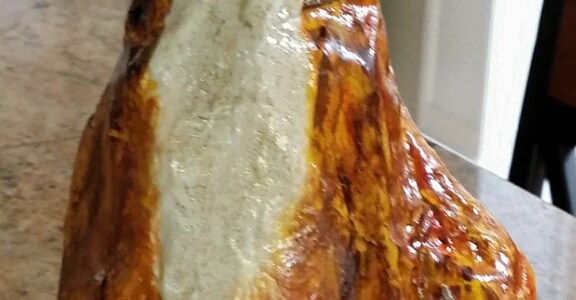
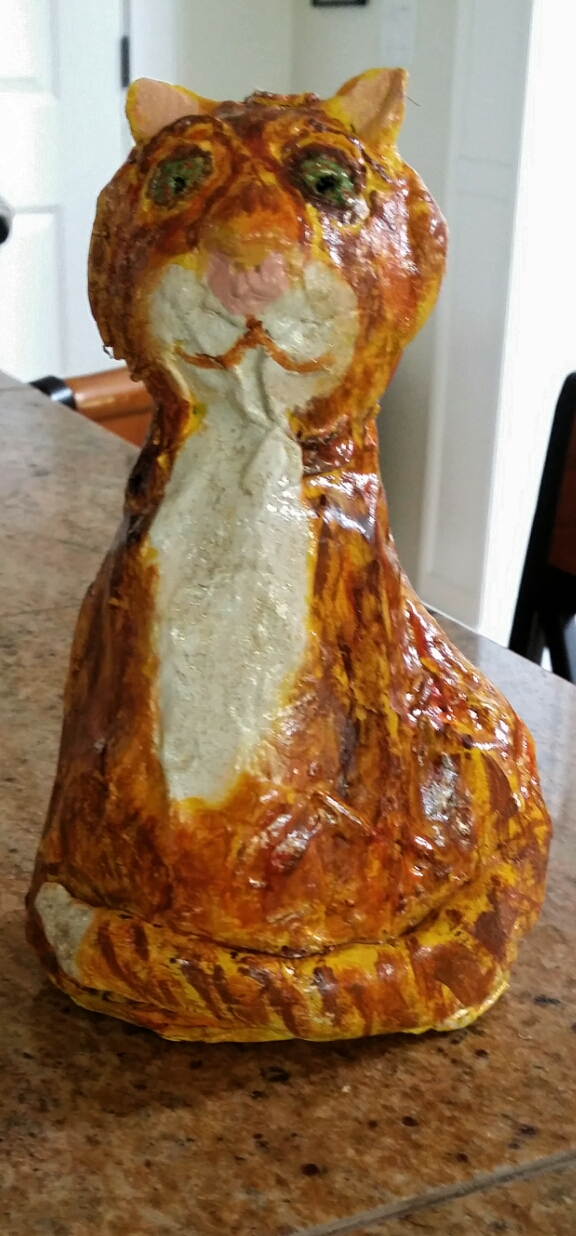
It is not surprising that when I took up paper mache, cats are the first series I worked on.  The cats I have created from various materials have some connections to my past.  For example, the featured orange cat reminds me of my first cat, Puddy Cat, who we got when I was in first grade. Puddy Cat lived at our family home for 21 years (far longer than I did).  Paper mache, Puddy, has a body entirely of newspaper to provide structure.

20160706_140956
Paper Mache, Puddy Cat

I wadded up paper into balls in the shape of a cat and then taped the paper in a few places to hold it together.

20160617_212815
Brindle Cat with coat of many colors

After I completed, Puddy Cat, I worked on a replica of the Satchel, the lord of the Ashtree Manor.  My first effort at Satch  was constructed of a toilet paper roll and Styrofoam ball for the head.  There was no effort to capture the shape of a cat but rather to express the sleek, stylish nature of a cat through paper.  I was pleased with the actual shape which I may try again.  But the color was all wrong.  I started with a black base coat and instead of creating a grey tiger stripe, I ended up with a brindle cat.  I call this cat, “Cat with Coat of Many Colors”.   My son told me that you always have to begin with base coat being light and then add on the darker colors later.

20160705_122116
toliet paper roll and paper mache frame
20160706_140859
Satchel in paper mache
20160422_150516
The extremely handsome Satchel

My next effort at Satch was a combination of experimenting with glue-based paste which creates a white clay and two toilet paper rolls.  The cat structure that evolved from this effort was quite elaborate.  I painted the cat all white and then layered on the various tones of gray.  I am pleased with the coloring but probably won’t do such an elaborate cat structure in the future.  To accurately capture Satch’s beautiful coat, I need to start with a gray base and then layer on.

I am working on paper mache prototypes because I need to have 10 items for a Christmas bazaar, a fundraiser for women’s scholarships.  When I took in the cats to the planning committee, they didn’t think that cats would sell well at Christmas. I am  now moving on to Christmas angels.  I will blog about my angels, wood nymphs, and sprites soon.

I learned when I was visiting one of my good friends in Wyoming that she spends many hours joyfully engaged in adult coloring. She has many beautiful, brightly huged pictures she has produced.  Coloring for her provides a grounding effect.  Adult coloring has become very popular by providing stress relief and improved fine motor skills.

I told her I got similar joy from working on paper mache. The big different is the coloring books are easy to carry and the pens can be packed in a box.  I have paper,  paint, and glue strewn all over our upstairs playroom. Fortunately, the kids have outgrown the room so I can leave my objects out to dry and paint for long periods of time.

The distinction between art and craft is that art is a creation from an emotional response that cannot be replicated.  Craft usually has a structure and can be replicated by others.  Most of the time, I would define paper mache as a craft with structure and the ability for others to copy.  However, I think in the case of my crafty kitties they are more art than craft.  I will probably not make more cats but the ones I have made have reminded me of my furry feline friends.

Top Ten Ways I know My Son is Home From College for the summer

My twenty-two year old son is home from college for the summer.  He has one more semester left before he graduates and is interning at Simplot in Strategic Optimization this summer.  The atmosphere in our house changes when he is home.  The top 10 changes are:

Number 10: The day of arrival the front door and entry hall, approximately 12 feet square, are blocked by a 36 inch smart TV, 30 boxes of size 14 shoes (my son collects Nikes and resells them online) and numerous boxes of assorted sizes filled with who knows what.

Number 9: The second day of arrival the smart TV, playing rap music, can be heard in the entry hall through the  door of my son’s  second-floor room. The entry hall otherwise remains jammed with college gear. The closed bedroom door is marked Scott Kozisek, Please Knock.

Number 8: By the end of the first week home, the entry way is empty except for a large backpack propped against the wall and camel pack, laying on the steps, both will probably remain there all summer.   My son’s possessions are now leaching out of his bedroom filling up the 12 by 12 landing at the top of the stairs and hindering access to the playroom.

Number 7: Household dynamics are slightly off kilter, like falling down the proverbial rabbit hole. My son is a vegetarian, a dozen eggs last three days instead of a week. Grocery shopping is expanded to include tofu, dozens of eggs, chocolate milk,whey protein. Our three car garage is challenged to provide parking for our fleet of four cars, juggling cars and keys is now the norm. Beautiful sound systems up and down stairs  play competing music with jazz, James Taylor, and Carole King dominating downstairs and hip/hop, rap, and electric dance music echoing through the upstairs.

Number 6:  I hear the front door opening and closing at 2:30 or 3 a.m. on Friday and Saturday nights. Or I don’t hear anything and get a text in the morning about crashing at friends. I have to continually remind myself that my son is an adult and can make his own choices. My tongue aches as I bite it to keep from saying something that I may regret or may damage our relationship.

Number 5: The dogs, Shani and Violet, whine and beg to get out of my office where I am watching TV or working on the computer whenever  their hero, my son, comes in the back door. This adoration for the lost boy is somewhat annoying since I continue to do all the feeding of the pets.

Number 4: I hear shouting at 11 p.m. between my daughter’s and my son’s bedrooms about a large bug that must be removed from my daughter’s ceiling fan. My son’s removal efforts result in random dust explosion and the bug being knocked off the fan onto my daughter’s bed.  More shouting erupts when the bug in a remarkable rebound returns to the fan.  Using my daughter’s belt, the bug is exterminated by my son. Because my daughter is unwilling to touch such an ugly thing, my son must extricate the insect from the down comforter.  Placing the bug in the trash will not do.  It must be flushed down the toilet to ensure the room has been de-bugged. I hear the vacuum turn on. I go upstairs to investigate. My daughter is vacuuming her bed, guaranteeing no other bugs have lived through the dust bowl event and removing the remaining dust mites from her quilt. Interactions of this nature will ensue throughout the summer, when previously the upper floor was silent.

Number 3: The amount and quality of conversation at the dinner table has increased geometrically with the addition of a third adult. We have moved from discussing high school and the weekly schedule ( who is going to be where and when) to discussing politics (no one in our family likes Trump though there is division on which Democrat to support), upcoming music and events in Boise, hit summer movies (who has seen what and who wants to go to what) and weekly schedule (who is going to be where and when).  We managed to coordinate well enough at dinner to allow us all to see Captain America Civil War together the first week it was out.  A good movie for families with kids 13 and up. We have also managed to schedule our Father’s Day Celebration for Wednesday, June 15th attending Alive After Five.  That was the closest date, we could find when we were all in town.  Kayla has a particularly busy summer traveling to camps and mission work all over the country.

Number 2: I have someone to watch streaming of Dare Devil , Season 3 on Netflix late at night.  We are moving on to Jessica Jones. My son is watching the third season of Peaky Blinders, his favorite show. I watched my first episode this week. Peaky Blinders  received a rave review in the Wall Street Journal  as a fabulous period piece. Focused on Irish gangs in London after WWI,  the episode I watched was bloody but haunting. My daughter by comparison and I watch Bones, America’s Got Talent, Kids’ Baking Championship and Chopped.

Number 1: I get regular hugs for making coffee in the morning and for packing lunches to send out the door to work.20160605_141159

Creating art is in our DNA

The  Essence of Art:  man’s selective re-creation of reality (Ayn Rand)20160527_190313

Creating is in our DNA. The earliest documented art, found  in Indonesia, are carvings in a shell with a shark’s tooth dating back 540,000 years (pre Homo sapiens). Just this week, scientists in France dated elaborate stalagmite structures in a cave underground back to those supposed stupid, rude and untalented Neanderthals thriving over 150,000 years ago.

Pottery, objects made from fired clay, are the first synthetic objects made by humans. Since clay is found throughout the world, a variety of objects from many places have been found dating  about 30,000 years ago. Relatively, new in the scope of world affairs.

Man started making pottery when we evolved from a hunting and gathering into agricultural societies. That makes perfect sense to me.  Nomads chasing wildebeests with rough edged arrow heads, hand-carved from rock, would probably not be inclined to haul a lot of earthenware around with them. Crockery, the growing of grain, and cooking seem to all go together not only in man’s development but in my sense of the history.

Pablo Picasso once said, “Every child is an artist. The problem is how to remain an artist once he grows up”.  Since I retired in November, I have been awaking the inner child artist in me.  As regular readers of this blog know, several weeks back I have been busy with papier-mâché (see https://wordpress.com/post/julierobinsonblog.com/2549 ).  Starting in March, I took an 8-week beginning pottery class at our local community center.  The class met every Wednesday for three and half hours.  There were ten of us in the class. Most were seniors though we had one very talented younger woman, who had moved to Boise a year ago, and two young disabled male adults.  Several of the retired women had taken the beginner class previously and worked on their own projects instead of following the prescribed class instructions.

Our instructor, Chris, is coordinator of the arts at the community center. He is Irish with bright red hair, a quick smile, great patience and kindness.  He holds a degree in fine arts from Boise State and is a master potter, known in the region for some of his works.  He told us he couldn’t imagine getting through college until he discovered pottery in high school.

Our class began with learning how to throw pots on the wheel.  I found I was not good on the wheel.  My legs would shake and subsequently my hands, braced on my legs couldn’t find “center”. “Center” is a key beginning point of pulling a beautiful tall pot.  As a beginning class, most the wheel-thrown pots stayed at 4 or 5 inches and were shaped largely like coffee mugs.  But my pots were only about an inch and that was after great help from Chris.  I couldn’t find one of my pots to glaze but the one I did is glazed in my favorite blue.

Scott, my son, says it looks like an ash tray.  But I’m using it on my dressing table to hold earrings.  I love the color.

One of my thrown pots started to go off kilter. At about this time, Chris told us to start using our imagination to make our pots more whimsical.  He meant different heights and designs on the wheel.  But I took his directions to be an invitation to move into fantasy land. I pulled my thrown pot further off center.  I subsequently marked up the skin of the pot with wood imprints.  Once stained brown and green, I think of it as my “tree trunk” entry into Neverland and the lost boys.

I found I was in my element working with slabs of clay. The slabs are made by kneading the clay into bricks and then pulling the squares through a roller.  The resulting slab is about ¼ inch thick when appropriately rolled.  Our first slab assignment was a box with a lid.

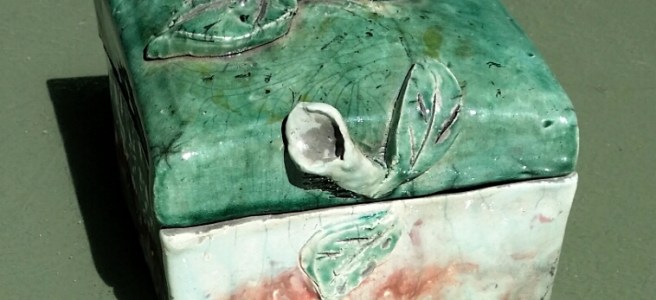
The box is made by careful measuring, cutting with an exacto knife, piecing together the parts and then hitting the clay with flat wooden spatula to solidify the form for firing. My box has a Daisy on top. I had a grandmother named Daisy and my niece is named Daisy. The Daisy is also the symbol of PEO, a philanthropic organization that provides scholarships to women. My sister is the current state president of, Idaho PEO, an organization of over 3000 women.  My mother was the state president of PEO in Wyoming when I was in high school. On the front is a white calla lily.  My daughter, Kayla, is named after the calla lily which grows wild in China and Idaho (see https://wordpress.com/post/julierobinsonblog.com/1742).

I have my box sitting above my computer in my office, a reminder of how many strong women have supported me in my life. The colors are a little too greenish for my taste but this is the result of limited choices for our first glazing experience.  We had a choice of two whites, a non-shiny copper and the green iridescent.  I have learned while watching others glazing in class, glaze is not a precise science.  One has to put on the glaze and wait to see what emerges from the interaction of fire and paint.

My final product and probably my artistically best object is a pinch pot. The pinch pot is made by taking a clay in the shape and size of a baseball  and slowly pinching it into a pot.  As the class went on, we all became more experimental and creative.  I created stripes and circles on the pot with waxed paper coated on back with a sticky substance.  Areas covered with paper when dipped in the first glaze could be left to turn black, the result of no glaze. This can be seen on the black areas of the daisy and calla lily on the box.  I chose to pull off the paper and dip my pot again in the white bubble glaze.  This glaze provides texture and resulted in the copper accents where previously I had paper strips.  I have this pot proudly displayed in my living room on our bookcase of art objects.  It seems to fit right in.

A number of my classmates chose to enroll in another class right away. I love the summers in Boise and would prefer to be outside rather than in a class room. After eight weeks, I picked up my tools, my pots, and donated my left-over clay to the community center.

I may choose to take the beginning class again in the fall or winter.   If I choose to take it again, I will focus on the areas that gave me the most joy, i.e. the hand-crafted items.  By taking the beginning class and trying both throwing pots on the wheel and creating free-form, I have much more respect for the technical skill necessary to throw a gorgeous pot.

Our instructor, Chris would tell us to listen to the clay and then your art will emerge. He cautioned us against starting with a preconceived idea of where to end up. Using this approach, I created an entrance to Neverland, a strong women’s box, and pinch pot dipped in the glaze called pond scum.  I found as Pablo Picasso advised my inner artist.


Jurni: providing a seat disguised as a bag

My family and I have travelled to the Orient, Europe, England, Ireland, Scotland, Mexico, Canada, Alaska, Hawaii and extensively in the U.S.  Our number one rule is that you have to pack so you can carry all your gear on the plane.  I have traditionally carried everything I need for up to ten days in a roller bag meeting airline carry-on regulations, a backpack and a fanny pack. I strap the fanny pack to my waist with my phone, money, and passport and only take it off at night to make sure my valuables and I are never separated. In a pinch, I can get the fanny pack into the backpack so I meet the two bag requirement of the airlines.

My two kids have been responsible for pulling their suitcases and  carrying their back packs since they were old enough to travel. Fortunately, bags and backpacks come child- sized. Kids don’t bring many clothes. The ones they bring are tiny. When the kids where younger, their clothes went in the roller bags and their backpacks were full of entertaining objects such as coloring tools, paper, Gameboys, and playing cards. All of this has become passé with the advent of  smart phones and iPods which entertain my children for hours. I see very young children playing with in airports now.

We made the decision  to wean down our wardrobes and keep our luggage with us because of lost luggage leading to problems at our destination. Now we travel with our luggage to assist in making connections if we have to change itineraries, reducing the problems of dealing with lost luggage and trying to keep the price of travel down. Taking four us to Spain or Hawaii and paying luggage fees for everyone becomes extremely costly.

Recently, I have become the drag on our traveling caravan. I have a very rare neurological disorder. I can walk just fine (for which I am very thankful). But I can’t stand for any period of time without my legs starting to shake. At the same time the lines for airport security are growing, my ability to stand is diminishing.

When my son and I travelled from Florida to Boise in March, I had trouble at the Pensacola, Florida security check. We had waited a long time. I told the screeners I had trouble standing but I couldn’t get them to listen. When I walked through the scanner, the equipment showed me carrying weapons all over my body i.e. in my arm pits, waist band, bra, anywhere that moved as my legs shook. After a humiliating body check, I complained to the supervisor who said I should have told the initial TSA worker. I had, of course, done this. In fact, I had told two workers but they were too busy to listen. Given this experience, I decided I needed to take matters into my own hands.

Flying home from Seattle a month ago, I received a text from Alaska Air that the lines at Seattle International Airport were two hours long. I asked for a wheel chair when I got to the airport. Once in the wheel chair, we zoomed right through the crowd. However, I was physically in better shape than the kind woman pushing the chair. As soon as I got into the boarding area, I was up walking around. I felt uncomfortable being pushed around when I’m perfectly capable of walking. Given the Florida and Seattle experience, I have done two things that I hope will improve my air traveling experiences.

The first is that I am now on the TSA priority boarding list. For a long time, I routinely got priority boarding but recently I have not. I am obviously not in a position to hope for the luck of the draw. I paid the $80 and scheduled the time to be fingerprinted. The next time I fly, I will enter my number TSA number and be able to skip the longer screening lines.

The second thing I have down is purchase the Jurni, a bag designed to  be a carry-on but also to sit on (https://www.indiegogo.com/projects/jurni-the-ultimate-sit-on-carry-on-suitcase#/) My daughter, Kayla, found the bag online when the luggage was still only a concept on a go fund me page. If you put in the funds to help develop the proto type, you got the bag when they were ready to be shipped.

My bag arrived this week. As promised, I can pull it easily  behind me and sit in it like a horse and scoot around the house. Now, rolling around a crowded airport may be a different thing altogether. Sitting on it like a chair is tipsy. I feel like I’m riding a rocky boat or I had too much to drink, a disconcerting feeling and the wheels can go out from under you throwing you to the floor. Thus, the bull rider approach with my legs anchored around the Jurni, I am in control of its movements for short distances. In other words, I would propel me along in a line.


The bag is tiny. I can see why it is designed for teenagers. My 16 year old daughter wears an extra small in most clothes and a size 0 in jeans. Until Kayla grew into these sizes, I actually thought they were pretend sizes to finish off the clothes rack. I remember standing in the Abercombie store when she shouted over the dressing room divider that the zero was too big and she needed a double zero.  Really,  a double zero! I wasn’t that small in grade school. Kayla could easily put a week’s worth of clothes into the little compartment designed for clothing.

I am not Kayla. While I am not enormous, I have grown heavier with age. The possessions I notice that now take up the most room are my bras which have grown geometrically since giving birth and breast feeding. The movement up to a D was bad enough but now on the downward slippery slope of aging, my circumstance is 2 inches bigger and I need wire armor to keep my cascading physique in place. The same is true of my swimming suit which used to be teenie weenie but now takes up the space of a small sea monster in order to pull me in all the right places and hold up those previously mentioned descending  upper body parts. Deciding what to take and purchasing travel clothes that meet all your needs while fitting  everything in small compartments takes significant planning.  My first thought when I looked in  the Jurni was I was going to need to  work on loosing more weight and buying a new  smaller traveling wardrobe (double zero, here I come!)

The good news is that the Jurni knows it’s packing compartment is tiny and for an extra cost has included zip bags to scrunch all my jumbo items into the size of my daughter’s size small. I tested the feasibility of utilizing the Jurni for a real trip rather than riding around my living room by laying out the wardrode I took to Mexico in January and seeing if I could fit it in the case. Much to my amazement, I got 3 pairs of long pants, 3 long sleeved shirts, 4 short sleeved shirts, 2 pairs of shorts, the iron maiden bra and sea monster swimming suit plus rash guard jacket, my traveling pjs (light weight), my wash out panties (3 pairs) seven pairs of white cotton socks ( I always wear socks with my hiking shoes) and  a pair of flip-flops. I actually called them thongs (my daughter was horrified). Appparently, thongs were shoe wear in the seventies but are strickly underwear in the twenty first century.

The little plastic buttons on the Jurni that serve as openers seemed a little stressed by my wardrobe. I am now on the look-out for a band to go around the Jurni once packed. The company sells a check-in strap and lock. But the strap goes from top to bottom and prevents you from utilizing the pull up handle. I would also be sitting on the buckle which  seems weird to me. I want something that goes around the middle, doesn’t interfere with the handle but guarantees that the iron woman underwear is not strewn all over the run way as I board a miniscule Alaska Airline plane where all carryons are actually always loaded under the plane.

I can’t provide a full evaluation of the campabilities of the Jurni until it actually goes with me on a journey. That may be a few months off. After jaunting all over the world and the U.S. the past few months, we are spending our summer in the Mountain West. Afterall, why go any place else when you are already there.

Frank Church Wilderness
Frank Church Wilderness Area, Idaho


Barney the Beagle–Paper Mache Replica of My Childhood pet

Papier Mache: French for chewed paper

Recently, I joined a women’s organization that hosts an annual Christmas bazaar to raise funds for education.   We are all supposed to make something to sell. I was born with very few arts and craft genes.   Since the first recorded cave art is over 500,000 years old, some of our early ancestors definitely had these genes and passed them on to a few lucky souls.  You and I all know the person who shows up  and can fashion a felt hat from a knit sweater or a gorgeous quilt from a rag bag, or takes home the hodge podge of objects contributed by parents to the school auction and produces a world class auction basket.  I stand in awe of these people.  I am not one of these people.

My freshman year in college, I took up knitting. I made dozens of extremely-long, odd- shaped scarves using the basic knit one/pearl one stitches.  Everyone I knew ended up with one of these slinky reptilian beasts.  As a child, my mother did her best to endow me with some homemaking skills.  I was enrolled in 4-H for a few years. I turned out passable aprons and gathered skirts, resulting in blue, red and white ribbons at fair.  My muffins had tunnels, little holes made by too much air–no ribbon at the county fair.  I did win the purple ribbon and best in class, one year for my meal plan.  In retrospect, this award is extremely ironic because I don’t cook much at all.

While suffering angst over the bazaar challenge, my sister, Jane, reminded me that as a child, I was a whiz at paper mache. My skill wasn’t because I wanted to produce great art.  I was fascinated by puppetry.  I’d make a variety of puppet heads with died cotton ball hair and whip up their outfits on our sewing machine. Then I would write elaborate plays for my friends and I to produce.

My first thought was there wasn’t much interest in paper mache anymore. I couldn’t have been more mistaken. When I looked up a paper mache refresher course on YouTube (source of all things educational),one sweet-looking elderly lady, Joni Good at http://www.ultimatepapermache.com  has a blog, numerous books and dozens of YouTubes.  Her recipe for paste has over a quarter of a million views. A second teenage girl has over 200,000 views demonstrating Joni’s recipe.  One man has over two million views on how to make a piñata. An attractive lady making a paper mache bowl has over 1 million views.

Apparently, there are a lot folks out there making craft items out of paper and paste. My sixteen year old daughter, Kayla, says there are just lots of people who like to watch YouTube and aren’t making anything. Surely these high numbers of viewers reflect some papery product being produced somewhere and not just viral surfers and paper stalkers. Given this huge viewing volume, I thought why not give it a try again? After all in the scope of human affairs (homo sapiens as we know them have  been around for more than 200,000 years), 52 years of not touching anything related to paper mache isn’t that long a time.

Paper mache originated in China during the Han Dynasty (BC 202 to 220). The Chinese made paper mache helmets that they hardened with lacquer. From China, the craft spread to Japan and Persia.  Those elaborate oriental masks, you see when you travel  are  paper mache.  When the art of paper mache reached France, the French, always unique, decided to create their art by chewing up the scraps of paper. Chewing paper would, of course, give you small pieces of sticky, damp paper to work with but sounds disgusting to me.  When I began my paper mache project, I rejected the French approach and used the yellow pages approach, “let your fingers do the shredding”.

After reviewing some of the videos on new approaches to paste (joint compound, linseed oil, and Elmer’s glue), I elected to go traditional. My first project is made of paste from flour, salt and water (recipe below).  A an empty toilet paper roll  and Styrofoam round ball provided the infra structure. I used newspaper for the coating.  Using household products did result in the bumps in odd places that led Joni Good to make up a more elaborate paste recipe.  But I am still taken with the more modest approach to paper mache because as a child, I remember we could just go to the kitchen, whip up paste without the hassle of gathering together a lot special stuff and have our theater cast underway in no time.  I think there is something to be said about being able to create when the urge strikes you, especially when children are involved.  In addition, the flour and water is easy to clean up with soap and water, inexpensive and very forgiving when you make errors.  Finally, it is not fast drying—a plus for joint compound and glue but a negative if you want to rip off some error you have made.

I am also taking a pottery class. In pottery, our teacher is always telling us that the clay speaks to us.  I was originally going to make a reindeer (remember this project started for the Christmas bazaar in 9 months). When I got started on the reindeer, he morphed into a beagle.

20160513_152202
Barney, before he got a coat of varnish, eyes and collar

I am very familiar with beagles, we had one when I was child.  For those art critics out there, I know the snout on my paper beagle is too long and his feet too big (blame the reindeer).  My sister, Jane, and I called our beagle, Barney the Beagle with the goo-goo-googlie eyes.  The entire time I was crafting my paper dog, I was thinking about Barney.  As you can see, Barney the Beagle has goo-goo-googlie eyes.


Barney was finished off with acrylic paints, spray-on shiny varnish, and repurposed eyes, nose and tongue from the reindeer I was trying to clone.  I found an unused cat harness in my pet drawer.  Any of you, who have read my blogs on my pets know that Satchel, the big gray Tom Cat wouldn’t be caught dead in a whoosie harness (one has to question my sanity for buying it at some point in time).  I cut up the offending harness and made a realistic collar for Barney.  Satchel was pleased.

I am proud of Barney for a first effort.

20160513_152019
Barney, with the goo, goo, googlie eyes!

He obviously isn’t good enough to sell at a bazaar, too many nasty little dings and bumps.  But he is good enough to give to my husband, Pete, for Father’s Day.  Pete has an office full of items the kids and I have made and seems delighted with whatever we give him no matter how low quality.


I have roughed out an angel and cat to see if I can’t still produce something that someone might buy. I may try the joint compound bending to the will of the masses to have a saleable product. Also from my pottery instructor, art takes time and patience.  I have nine months but at my age I’m not sure I will every produce a financially viable product.  That’s the beauty of paper mache. There isn’t much of an investment if the outcome is poor and you can also toss it in the recycling bin.

Simple Paper Mache Paste Recipe

1 cup flour

1 cup water

3 teaspoons salt

Mix together and start gluing

Most important–Have Fun!

My Tiny Arizona Home, the right size at the time

I am an HGTV (Home and Garden Channel) fanatic. I particularly like House Hunters International and recently, I have started watching Tiny House Hunters.

landscape-1442330245-tinyhouset
Cottage Style Tiny House on wheels

I am intrigued by all the varied designs and nooks and crannies that can be folded into 500 square feet or less. I am also fascinated by the reasons people desire tiny homes.  The premise of the show is that Americans are looking to downsize, simplify their lives, travel more, and just save money. Probably my biggest reason for being interested in tiny houses is that I lived in a tiny home before there was a tiny house movement.


asu-251x240
I received a masters degree in sociology in 1975.

When I was a graduate student at Arizona State University (ASU) in the mid-seventies, my first apartment by myself was a  ground-floor studio  measuring approximately 200 square feet.  A studio apartment combines living, bedroom, kitchen into one space with a separate bathroom. While the new tiny homes may have many exquisite details such as granite, wood paneling on walls and ceiling, my apartment was the scaled down version with cinder block walls, rattan furniture in the living area, a formic dining table for two, wooden beads surrounding the  double bed for privacy, regular closet and a kitchen along one wall. The piece de resistance of the kitchen was the stove with an oven above, pull-out burners and an oven below.   In 1973, microwave ovens were not ubiquitous as they are now.  They were just starting to show up in high end kitchens (first counter top micro wave was distributed by Amana in 1967).  My home had a front porch with patio furniture looking out on a shared swimming pool and a back door that opened to the parking area.  The climate in Arizona is such that having the outdoor space is the same as adding a substantial amount of square footage, especially with a swimming pool available for everyone in the complex. The apartment complex and pool were well maintained and the location was close enough to campus to bike.

I felt like a queen in my special place. One couldn’t do much decorating because of the cinder block  walls. But I did have posters scattered about.  Unlike folks who are downsizing to a tiny house, the studio was  upsizing for me from  a dorm room and then a shared two-bedroom apartment. I had plenty of space for one and I enjoyed having my own privacy.

The biggest drawback to the Arizona place was not size but no pets.  I love animals.   When I was in graduate school, I didn’t really have the time or financial resources for pets so that lack of one was not  a problem.   A few years later when I had a regular job, one of my first goals was to purchase a house so I could have animals without the restrictions placed on pets by landlords.

My memories of Arizona are magical. I loved the University, the independence, the desert, the hot days and cool nights. I have memories of playing soft ball andpar 3 golf during day. At night, we would sip wine coolers on patios warmed by fire pits and accompanied by live music.  These were all new and exotic activities as a cowgirl who grew up in Wyoming and went to a Presbyterian College in Nebraska for my first experience away from home.

While I was at ASU, I had a number of guy friends. One of them, Dave, was a desert rat. He had an orange jeep and would take us out on extreme dirt roads to view the gorgeous red mountains, cactus and wild flowers, all found in isolated, primitive areas.  After one such adventure,  I was cooking my specialty, spaghetti with red meat sauce. Actually, I am not a good cook, so this was my go-to meal for guests. Dave and I sat down to a festive Italian meal and the next thing I know he’s bolting to the bathroom sicker than a dog.

Cleaning up in a hurry, I dumped everything down the garbage disposal immediately clogging the drain. The  maintenance man, Charlie, came right over with a plumbing snake to clear the line. When he started pushing it into the drain, we heard a scream next door. Apparently, the drains were connected and the metal snake had popped out of my neighbor’s sink–a startling experience.  Meanwhile, Dave was moaning on the bed behind the beaded curtains, not enough privacy in times of distress.

Then Charlie removed the U drain below the sink, emptied the nasty red sauce and slimy pasta contents into a bucket.  He promptly stood  up and dumped the bucket into the now empty sink. At which point, the entire contents of the bucket shot through the open drain making a huge mess on the kitchen floor and splattering Charlie and I.

Dave emerged from his bead sanctuary to see what the commotion was about. When he saw the mess, he decided he was well enough to go home and recover.  Dave and I never discussed whether the illness was brought on by my cooking or a rapid stomach bug. I do know he never chose to eat with me again. The lesson from this experience is that houses are like spoiled children in need of regular attention. They have the ability to throw a tantrum by breaking down, leaking, flooding, cracking, at the most inconvenient times. Almost anything connected to a house is expensive. A good do- yourself-person in the family is a gift.

The other memory I have of my ASU home is not so amusing. One week night, I received a phone call from my former roommate, Pat, telling me she was coming right over and to tell no one. When she got to my house, she had a fellow grad student, Kathy with her. Kathy was hiding from her abusive husband. I was the only safe place the two of them could find.  I was safe because I didn’t know Kathy’s husband. Kathy and I sat up all night because Kathy was terrified.  Unfortunately, this happened more than once. I had never seen anyone so frightened as those times Kathy was escaping her raging, violent husband.

There is a happy epilogue to this story. Kathy did finally divorce her husband. She finished her  masters degree,  successfully pursued a doctorate and became an expert in the field of family violence.  As Kathy and I sat together on those terrifying nights, I made up my mind that no one should be that frightened in their home. I have spent many years in Wyoming and Idaho volunteering for and donating to programs committed to providing safe havens for women and children who are victims for domestic violence.

The lesson from my experience with Kathy is that houses (the four wall structure) are not homes (socio-cultural experiences created by the individual(s) living in the structure). Kathy had a better house than most graduate students because her husband had a regular job.  But a physical structure that does not provide safety and is not a refuge in times of trouble is not a home.  Today, in our world we have many refugees fleeing unsafe settings (estimated at about 60 million people around the globe today).  Any night in the United States, there are over half a million homeless individuals (men, women and children). Domestic violence is the third leading cause of homelessness in the United States.  In other words, there are many people in need of refuge in our world today.

My 200 square foot studio apartment provided me with a lovely home for a year when I lived in Arizona.  My home was also a place of shelter for someone else in need.  I am grateful that my life has been blessed with  many homes filled with a great deal of love. Square footage truly doesn’t matter when seeking out a house, but the strength of character  and heart of those who reside within does.

gratitude


Top Ten Reasons Not to Vote for Trump

Donald shoutling
Donald Trump, Republican Presidential Candidate

With David Letterman gone, we now have to develop our own Top Ten Lists.  Below are my current Top Ten Reasons NOT to Vote for Donald Trump:


Number 10: No one, not even Mr. Trump, knows why Mr. Trump, decided to run for president. The rumor among political correspondents is that he wanted revenge for serving as the butt of jokes at a White House Correspondence dinners.( See Seth Meyers, Saturday Night Live Comedian’s presentation on YouTube: https://www.youtube.com/watch?v=0Km4R377s4M)

Number 9: By ridiculing every intelligent woman he encounters, Mr. Trump is the first presidential candidate to start a war, the  gender war, while running for office.

Number 8:  Mr. Trump tell lies faster than Pinocchio. Eight in 16 hours documented by the Washington Post, April 29, 2016.

Number 7:  Mr. Trump’s main source for guidance on foriegn policy is watching TV (The Fiscal Times,  August 17, 2015).

Number 6:  If elected, Mr. Trump will have four years to continue lobbing insults at people, places, and things through his twitter account. (See New York Times, updated April 4, 2016: “210 people,places, and things Donald Trump has insulted on twitter”).

Number 5: Building walls to keep people out is so-o-o passé  as foriegn policy.  After all, China built the Great Wall over two thousand, two hundred years ago.

Number 4:  Trump shares a bully bromance with Russian President Vladimir Putin.  Putin has called Trump “bright and talented” and Mr. Trump has acknowledged Putin’s strong leadership skills. Mr. Trump’s admiration is somewhat surprising since Putin has jailed his  critics, journalists and activists, shut off gas to the Ukraine and rest of Europe and sold weapons to Al-Assad.

Number 3: Mr. Trump can’t count.  More Mexicans have left the U.S. in recent years to return to Mexico than have come to the United States (Pew Research Center). Mexican immigration is decreasing because of declining birth rate, socio-economic factors and an aging population (Politifact, August 6th, 2015). Mr. Trump continues to assert despite these statistics that “people are pouring across the border.”

Number 2: Like a reality TV show on the Home and Garden Channel or a fish out of water, Mr. Trump is a master of  the Flip or Flop.  Recently, Mr Trump  said he could be “flexible” on his immigration policy because we need “talented and highly skilled people” in this country. “In terms of immigration and almost anything else, there always has to be some, you know, tug and pull and deal,”   (Mr. Trump, March 3, 2016, Fox News Debate).

Number 1: If elected, we’d be foreced to see Mr. Trump’s hair, strangely akin to golden, spun-sugar, cotton candy from a carnival regularly on the nightly news.

Trump Bad Hair Day
Mr. Trump having a bad hair day. The wind whips his  hair up like a sugary dessert confection.

Worst picture


The Global War on Morris–humor with a bite!

The Global War on Morris (Simon & Schuster, 2014) is a political satire written by Congressman Steve Israel, Democrat New York.   My  first thought when beginning Morris was how a  13-year Congressman has time to write  a novel, particularly a representative who headed  the Democratic Congressional Campaign Committee.  On second thought, maybe the debacle of the last congressional elections for Democrats can be credited to Congressman Israel focusing on his novel rather than elections. The current deadlock in Congress has probably given all  435 Representatives and 50 Senators tremendous time on their hands to engage in creative writing, playing cards, hunting with Supreme Court Justices  or other hobbies, since it is clear they are not engaging in the art of politics . The act of political civility as I  understand it requires endless conversations in the arena of ideas  with the goal of identifying compromise solutions. With no willingness to collaborate, there is plenty of time for personal ventures at the public expense.

But I digress, Mr. Israel’s book is a work of fiction crafted by  taking headlines of the War on Terror during the the Bush/Cheney administration and loosely  linking these actual stories into an amusing narrative.  All of your favorite Republican henchmen during the period, Karl Rove, Scooter Libby, Tom Ridge are alive and well in the story line. Vice President Dick Cheney is hunkered in an underground bunker, a Machiavellian puppeteer controlling American’s views on terror. The ultimate goal is not to protect the country from would-be terrorists but to beat Candidate John Kerry in the 2004 election.

I read the book because New York Mayor Bill deBlasio recommended it in the Wall Street Journal’s, Books of 2015 “Who Read What”. I realized once I started reading that the WSJ endorsement was probably a shameless plug from deBlasio for his Democratic friend, Israel, from upper New York.  The recommendation also provided an easy way for the Democratic leadership to spoon feed readers in a humorous forum fundamental constitutional issues  of privacy and civil right bludgeoned by the War on Terror.

Morris, of the title, is an unassuming, nondescript Jewish pharmaceutical salesman living a routine existence with his overbearing wife Rona, a clinical social worker.  These two conventional, average, liberal New Yorkers become mistaken as American terrorists by Cheney and his crew through a series of bizarre and comical  mistakes and poor life choices. As is true of many things in life, the real villains manage to escape while Morris becomes embroiled in an endless round of red tape and bureaucratic nonsense. Rob Reiner & Andrew Lenchewski are adapting the Israel book into a cable comedy series.  If you don’t enjoy reading, you may soon be able to see the plot on television.

While Israel is writing in the theater of the absurd, two real-life points jumped out at me. First, I know Vice President Cheney personally.

Cheney
The author knew Dick Cheney when he was first elected to Congress before he turned to the dark side.

He is from my home stomping grounds of Wyoming.  When he first ran for Congress, he was young and unknown.  I remember receiving a phone call asking me to host a house party for Cheney at my rented bungalow on the fringe of gentrified Cheyenne, Wyoming.  The caller said, “We are having trouble identifying people to support a younger, unknown candidate.”  Cheney, of course, went on to win the election.  In my executive job, I remember visiting him in Washington where he always had time to see Wyoming constituents, particularly those who had helped him get elected.  I also remember running up steps of the stadium at the University of Wyoming football game as Representative Cheney was coming down them.  He called out, “Hello, Julie.” So what do we learn from these little tidbits from my past.  First, everyone starts somewhere.  It is still possible in this country to start out as an unknown candidate and over a long, successful career end up as a Secretary of Defense, corporate titan, and Vice President of the United States.

We also learn that people change.   I have turned into a liberal as I age and see the haves becoming wealthier and have not’s becoming a permanent underclass.  My Democratic friends in Wyoming tease me mercilessly about my support of Cheney but then my sister and I were also Goldwater Girls back in the day.  The same can be said of Cheney.  The man, who was gracious at a rental house party, saw and knew his constituents by name and rose to power in an unlikely manner, seemed to move to the dark side as his career jettisoned.  The lesson here is not that I moved towards the light and he moved towards the dark but rather in life there are many opportunities to change.  I heard a wonderful presentation on homelessness a few weeks ago and one of the featured speakers when queried about the potential of the homeless to improve said quite clearly, “My approach to homelessness is based on my belief in redemption.  No matter how many drugs a person has used or how long they have been homeless, redemption is possible.”  Now in my 65th year, I see where every day there are opportunities to choose the light or dark and we each must define and build our own personal trajectory.

Second, we learn from the tyrannical vision of the unfettered Federal government, that as Americans we do have some very real concerns about the balance between protection of privacy and the need to know to keep us safe. I have to admit that I have not been in favor of Apple’s opposition to providing the FBI with information about how to unlock  the San Bernardino shooter’s cell phone. These people are known killers who willfully shot their co-workers in a planned attack.  The haunting question remains are there others out there waiting their time to strike?  If so, is that information contained in the cell phone data? The Global War on Morris reinforces Apple’s position.  A government with complete access to our personal information and without any oversight body could quickly germinate into an authoritarian regime seeking out anyone who disagrees with it.  I am not sure what the correct answer to the balance of personal privacy versus terrorist among us is.  But after reading the book, I do agree with Apple CEO Tim Cook that this decision  must not to be taken lightly.

apple versus FBI
Apple versus the FBI raises important questions about the right to personal privacy versus the government’s right to know.